In this series, Spektrix demystifies and unpacks the benefits of dynamic pricing for the arts, helping leaders make informed decisions.
Think back to the last time you set pricing for an event. Where exactly did that price come from? How cumbersome was the process? And how responsive was it to the needs of your audience?
Now is a good time to think strategically about how your organisation can build confidence in setting prices – dynamic pricing can guide this.
Dynamic pricing uses multiple data points to support users as they set prices. You have likely encountered the term in headlines and in conversations across the sector, for better or worse, with a lot of attention given to a few public examples of how dynamic pricing can be misused. However, audience members and arts, culture, live experience organisations alike can benefit from dynamic pricing when it is guided by flexibility, trust, and fairness.
At Spektrix, this topic needs careful consideration, and it may not be the right approach for every organisation. The priority, as always, is to support organisations across the sector, and the best way to do that is to share enough information for teams to fully understand the opportunities available to them.
You do not have to go it alone. The Spektrix team is here to advise and facilitate conversations with dynamic pricing partners and sector experts. So, what is the power of dynamic pricing in the arts? Here are a few ways this strategy could make an impact for your organisation.
A dynamic pricing model creates responsiveness and flexibility
The first benefit of dynamic pricing is that it is, well, dynamic. It changes, and it reacts. In this day and age, flexibility, wherever it can be found, is key to adapting to the needs of your audience.
A successful fixed pricing model requires you to make assumptions about audience behaviour and accurately predict trends – easier said than done. Audiences have changed drastically, or fallen away, in the turbulence of recent years, with factors like Covid, the cost-of-living crisis, and lack of funding all playing a role. With so much happening outside your organisation’s doors, it can be difficult to benchmark and easy to second-guess yourself as you set prices.
Price tickets too high, and venues remain half-full; too low, and potential revenue is lost. Dynamic pricing automates price adjustments – both up and down – within a set range. This enables swift reactions to demand fluctuations, better sales predictions, and revenue forecasting. The automated nature of dynamic pricing reduces manual interference, yet with human oversight, adjustments can be made swiftly when conditions change unexpectedly.Pal Danyi, PhD, Chief Development Officer
DynamO

Unlike a fixed pricing model, dynamic pricing works when demand is not as expected, and it can help create, steer, and predict demand. It can accelerate slow sales, or it can maximise profits for a smash hit. In fact, DynamO reports that adopters of dynamic pricing strategies have seen immediate revenue growth of 15-20%.
Instead of stumbling backward after an unexpected development, your team is better positioned to respond quickly and move in the right direction.
The right dynamic pricing strategy builds confidence and trust
There are plenty of stories about big-name concert tickets rising to unfathomable prices. And with the deep relationships between arts organisations and their audience, it is understandable that thoughtful leaders want to avoid exploiting or intimidating audience members in the same way.
But, as Digonex Director of Marketing Kelly Degenhart puts it, those stories are “the exception, not the rule.” When done with intent, dynamic pricing can strengthen customer relationships and support an audience loyalty model centred on your audience’s needs and values.
Good data supports your audience and your team
Your pricing strategy should not be a trust fall – closing your eyes, setting a price, and hoping your audience will respond.
The first step in any trusting relationship is paying attention – and in business terms, that means collecting data and understanding how to build a dynamic pricing model. One of the most powerful benefits of dynamic pricing in the arts is the information it gives your team, providing data points and reports that can be put to use.
When you back decision-making with real, actionable data, you build reasoning that supports both your organisation and your audience. You are better able to understand how audience members behave, who your most loyal audience segments are, and how to respond to their needs.
Craft your ticket pricing strategy with your audience in mind
Just like any tool in your toolbox, dynamic pricing can be used thoughtfully and intentionally.
Box office teams particularly value the pricing strategy feature. It allows them to set a primary objective, whether it is to fill seats or optimise revenue, and the pricing adjusts dynamically to align with that goal.Bence Marosi, CEO
DynamO
You can, and should:
- Set maximum prices for each show to ensure they never become out of hand.
- Be proactive about making space for audience members who buy at lower price points.
- Advertise your price ranges clearly so that audience members understand their options.
While a dynamic pricing model may be enhanced by technology, it remains fully within your control.
Take your audience with you on the journey
Dynamic pricing depends on clear communication and transparency. Include clear information about your pricing policy in your terms and conditions, and do not hide the price ranges. Meanwhile, make sure your sales and front-of-house teams fully understand the model and can explain it clearly when questions arise.
Trust is a muscle. The more you communicate, set expectations, and follow through for your audience, the stronger that relationship can grow.
How to get started with trustworthy dynamic pricing
Be clear about your objectives for dynamic pricing
While revenue enhancement matters to many organisations, many care just as much about filling seats. Often, the optimal price is a lower price. When Digonex works with clients, the team takes time to understand objectives at the performance level and adjust price recommendations accordingly.
Build in appropriate constraints and controls
This may seem obvious, but an effective dynamic pricing strategy sets clear constraints and rules such as minimum and maximum price thresholds. Digonex builds these types of constraints into its solution so that price recommendations align with clients’ price range tolerances. Digonex also provides a simple-to-use web portal that allows clients to review and approve, reject, or override price recommendations with the click of a button, so the client always maintains visibility and control before recommendations are sent into the ticketing system and website.
Take a holistic view
It can be tempting to focus disproportionately on only the most obvious opportunities – such as increasing prices on the premium seats for a strong-selling performance. In Digonex’s experience, however, there is a lot to be gained by taking a holistic view of how a house is priced. For example, it is possible to capture the yield opportunity on premium seats while also retaining a low-price section and optimising relative prices across the house to fill it more effectively. Many clients also use subscriber prices to help set the lower bounds for single tickets, making sure subscribers always get the best price.
These are a few of the techniques Digonex uses to help dynamic pricing generate strong outcomes for clients while also preserving, and sometimes strengthening, the long-term relationship between arts organisations and their audience.Kelly Degenhart, Director of Marketing
Digonex
Dynamic pricing makes your strategy more fair
Maybe you have been here before: it is the week before the show, demand was not what you expected, and you have not sold enough tickets. So, a quick promotional offer goes out to your email list to try to fill those empty seats.
This can be an effective short-term fix, but when you stop to think about it, is it really fair?
Dynamic pricing creates opportunities for savings from the start, with clear purchase pathways for a wider range of audience segments. It gives you greater control over the values behind your pricing policies.
Really get to know your audience’s motivations
Audience members have different motivations for choosing their tickets and deciding when to buy, including:
- Financial – They want the cheapest tickets or the best perceived price-value ratio.
- Experiential – They want to make a night of it and book the best seats in the house.
- Altruistic – They want to support your organisation.
A fair pricing model speaks to all of these motivations so the value proposition is clearer. But with a fixed pricing model, it is harder to support more than one group at a time.
The continuous stream of data built with a dynamic pricing partner provides more comprehensive information about your audience and what those motivations may be. In addition to revenue-related data, it also gives behavioural insight. From there, new opportunities start to emerge.
Some audience members, for example, love a deal and would take advantage of lower-priced tickets, branching out from their usual programming or attending on off-peak nights. Others may always prioritise coming on a weekend or seeing a particular act.
With more of this data in hand, you can reach your audience in a more holistic way. Aim to create incentives for each type of motivation so that a broader range of your audience feels recognised and rewarded.
Reward loyalty and early booking
Early booking and audience loyalty bring major advantages to your organisation, creating more predictable revenue. But reactionary price drops can easily undermine those efforts if audience members come to believe that the best price comes from waiting.
Let’s go back to the example above. Ultimately, drastic last-minute deals can penalise the people who book early – often your most enthusiastic supporters. But with dynamic pricing solutions, you can generate demand and be intentional about which behaviours provide access to the best price.
You can see this clearly in the chart provided by Spektrix client Bristol Old Vic, the oldest continuously running theatre in the English-speaking world and a hotspot for cutting-edge theatre. The theatre began its dynamic pricing strategy in 2018 and immediately saw results.
In the blue line, which depicts average pricing across all organisations, the price of tickets goes down over time as discounts roll out. That means the earliest bookers are paying the highest price.
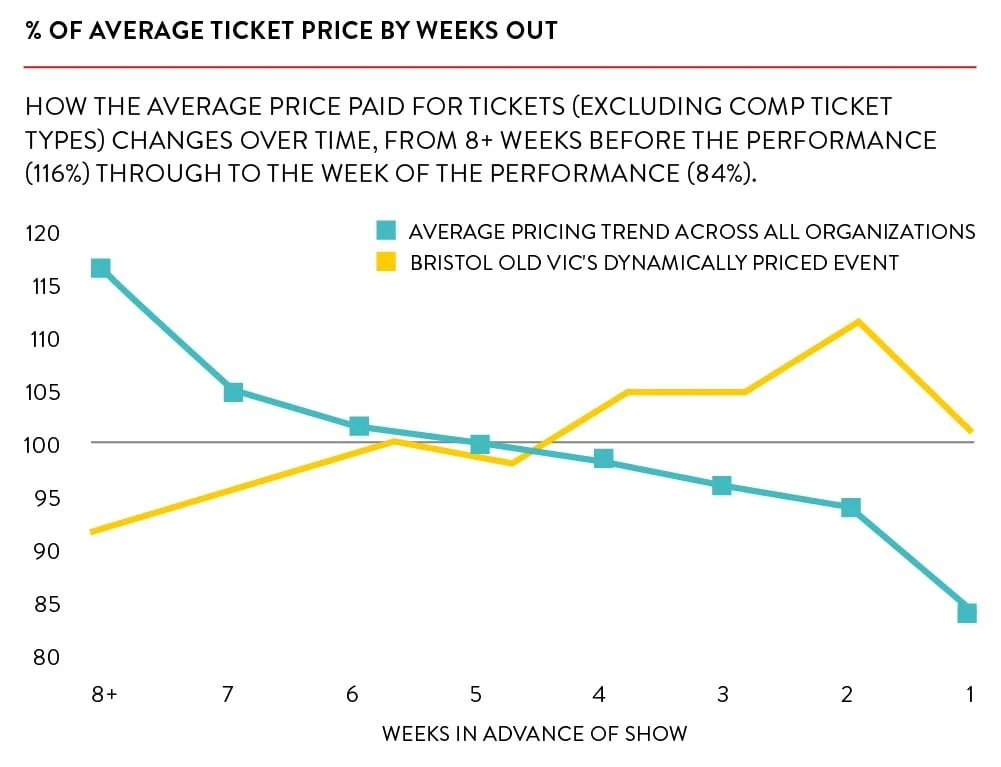
With Bristol Old Vic’s dynamic pricing model in yellow, the cost increases over time. By setting its pricing strategy this way, the theatre avoids penalising audience members for booking early.
Your audience will understand this too. Think about booking a plane ticket. If you book your flight the night before, you would probably expect to pay more because you are booking at the last minute.
When audience members know they can consistently get the best price by booking early, you can help shape behaviour and build demand while also rewarding early bookers.
As audience motivations become clearer, it also becomes easier to see where dynamic pricing overlaps with other loyalty models, especially when altruistic motivations come into the mix. The data that helps you understand your audience’s motivations can also support subscriptions, memberships, pay-what-you-can, and other flexible pricing models. Once again, you have more control over how your organisation’s values are reflected in your pricing policies.
Unlocking the benefits of dynamic pricing
Dynamic pricing can help organisations benchmark prices and build confidence in setting them. It supports theatres and arts organisations by helping teams better understand their audience and build a stronger audience loyalty strategy.
Now that you understand the benefits of dynamic pricing, the next step is to look more closely at whether it is the right fit for your organisation and how to implement it. Spektrix and our partners are here for consultation and advice. Let’s continue the conversation.