Understand CMA price transparency guidance and how to use it to build clearer pricing, stronger audience trust, and long-term sector health.
Ticketing is more than a transaction. For arts, culture, and in-person experience organisations, it is the start of a relationship – and the experience you create in those first few clicks can shape that relationship for years to come.
That is why we are strongly in favour of initiatives that make pricing clearer for customers, and that help organisations build lasting trust with their audiences.
When people can see what they will realistically pay upfront, they can make confident choices and are more likely to return. When they cannot, trust erodes quickly, and the whole sector feels the impact. It also creates added pressure for box office operations, as teams spend more time managing confusion that clearer pricing could have prevented.
In the UK, guidance issued in November 2025 by the Competition and Markets Authority (CMA), prompted by the Digital Markets, Competition and Consumers Act (DMCC), which came into force in April 2025, is part of that wider push for price transparency. And while the principles are customer-friendly, some of the practical detail – especially around per-transaction fees – has left organisations understandably asking what “good” looks like in real life.
This blog is a guide to the portion of CMA price transparency guidance that is generating the most questions: per-transaction (per-order) fees, and how you can respond in ways that support both compliance and long-term audience relationships.
Why CMA price transparency guidance is coming up now
Though these guidelines rolled out a few months ago, there has been renewed discussion in the sector about how fees – particularly per-transaction fees – should be displayed at different points in the customer journey under the DMCC Act and CMA price transparency guidance.
The rules and guidance have been developing over time, and many organisations have already made changes to how they present fees in marketing, on their websites, and across their wider audience journey.
The underlying aim is straightforward: customers should be presented with the price they can realistically expect to pay, including unavoidable fees, so they can make informed decisions and feel confident coming back.
What CMA price transparency guidance is trying to achieve
The DMCC and CMA guidance on pricing are not limited to ticketing. They form part of broader UK legislation aimed at reducing “surprise” costs across online commerce – from holiday bookings and hotels to retail delivery fees.
Within that wider context, there are two principles that matter most for arts, culture, and live experience organisations.
- Make total pricing clear early. If a fee is unavoidable, customers should be able to see the true price they will pay, not just a headline number that changes later.
- “From” prices need to be meaningful. If you advertise “Tickets from £X”, that number should include unavoidable fees that can be calculated at that stage.
That is the intent behind CMA price transparency guidance; where it gets nuanced is how you apply that intent when some fees depend on the contents of a customer’s basket.
A key distinction: per-ticket vs per-transaction fees
CMA price transparency guidance hinges on never hiding compulsory charges from the customer, and on making it simple for audiences to understand how prices are built.
Per-ticket fees are directly linked to an individual ticket. Because they apply in the same way to each ticket, they can be clearly displayed in a way customers can easily understand, and folded into your wider approach to audience pricing.
That means they must be included in the ticket price shown to the customer as a single figure – not itemised separately.
Per-transaction fees are more complicated in practice. They are applied once per order, and any “per-ticket share” would change depending on what ends up in a basket. That could vary based on the number of tickets selected, or where someone is booking for multiple events in one transaction, for example during a season launch.
When advertising the cost of purchasing a ticket to an event, for example the minimum amount one person needs to spend, you must include the transaction fee. However, when displaying the per-ticket cost in the commerce flow, for example on the seating plan, there is the potential for confusion if every price type is inflated with a fee that is only charged once per transaction.
We have looked carefully at the examples in the CMA’s guidance and discussed our approach with STAR (the Society of Ticket Agents and Retailers), the UK’s self-regulating body for ticketing, to ensure that Spektrix aligns with industry understanding of the CMA’s expectations.
So what does a practical, customer-friendly approach look like?
If you want to continue using per-transaction fees, there are practical ways to do so that support compliance and keep the experience clear for customers and audiences. Some organisations may also choose to remove per-transaction fees altogether, or move toward more inclusive pricing models that make the total price clearer from the outset. The right path will depend on your commercial structure, the audiences you serve, and the partnerships you have in place.
Early-stage marketing: Make “from” prices real
The CMA refers to early-stage pricing as the “Invitation to Purchase”. At this point, “from” pricing should include unavoidable fees, including per-transaction fees where they apply.
So if your cheapest ticket is £20 and there is an unavoidable £2 transaction fee, your marketing “invitation to purchase” price should reflect £22, with the breakdown explained underneath where helpful.
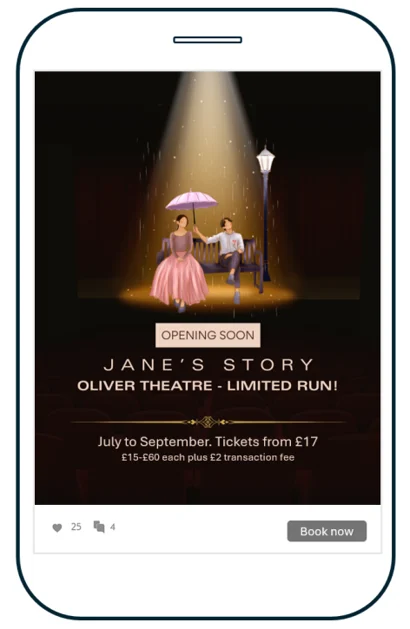
Image from Competition and Markets Authority Guidance on DMCC, November 2025.
This clarity matters beyond your ticketing journey. Customers may see your pricing in several places before they ever click “Book now”: listings pages, event pages, emails, third-party promotions, billboards, and partner marketing.
A good next step for most organisations is a quick audit: where do we show prices publicly? Where do we use “from £X” language? Are we consistent across every touchpoint our audience sees?
Seat selection: Clarity without distortion
At seat selection, per-ticket prices should include any per-ticket fees as a single figure, so audiences see a clear, accurate price for each ticket type.
With per-transaction fees, a clear and compliant approach is to display the per-ticket price accurately and signpost the fee clearly as a per-transaction charge. Customers should understand that it applies – but it does not make sense for it to be forced into a per-ticket figure that cannot yet be fairly calculated. You can see an example of this on the CMA’s guidance for their “Flower Show”.
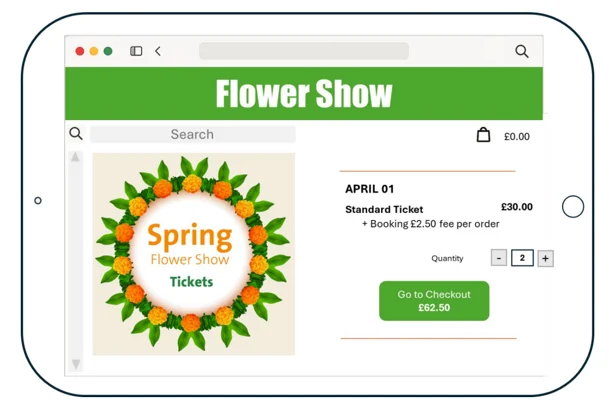
Image from Competition and Markets Authority Guidance on DMCC, November 2025.
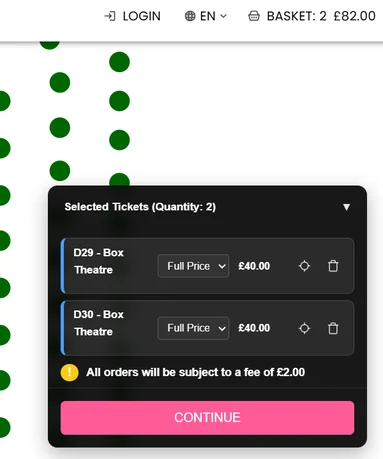
Additionally, the basket summary displays a running total of all tickets + transaction fee.
Basket and checkout: Be explicit, and calculate totals automatically
Once the customer has started building a basket, the ticketing system does the maths for you. This is the point where per-transaction fees become concrete and the customer can see a true total.
Best practice here is to:
- Make the per-transaction fee visible (clearly labelled as “per order” or “per transaction”).
- Ensure the total price is calculated automatically.
- Where possible, show a running total that includes all unavoidable charges.
This approach makes it easy for customers to see the full amount they will pay before completing the purchase, supporting compliance while keeping the journey transparent and focused on audience trust.
Compliance goes beyond checkout
It can be tempting to focus purely on the booking journey. In reality, pricing risk often arises earlier – in advertising, marketing copy, and third-party promotions.
If customers see “£20 tickets” in marketing, but unavoidable fees are added later, that is where confusion, frustration, and complaints tend to originate.
It is also worth thinking about partners – promoters, visiting organisations, membership platforms, and third-party listings. If they advertise your prices, they need the right numbers too. Reviewing pricing communication holistically – across your own channels and those owned by your partners – is an important part of responding to CMA price transparency guidance, and case studies like V&A Dundee show how connected systems and integrations can streamline operations while keeping data aligned.
A broader opportunity: Simpler pricing, fewer headaches
Many organisations use fees for understandable reasons – contracts, commercial structures, and the practical realities of funding operations.
However, this moment also invites a broader question. Rather than simply listing fees differently, some organisations are reconsidering whether the separation itself is necessary. Inclusive pricing – where unavoidable charges are incorporated into the headline ticket price – can simplify compliance and make audience communication far clearer. It is worth noting that this decision may require renegotiating commercial arrangements so that both the organisation and its producing partners share a structure that supports a single visible price.
That is not a small shift. It involves rethinking established business practices that were once the simplest way to operate, and aligning them with a more audience-centred, long-term approach. But as scrutiny of fees increases, it is worth asking whether older structures still serve the relationship you want with your audience, and the long-term sustainability of your organisation.
Final thoughts: Clearer pricing benefits everyone
At its heart, CMA price transparency guidance is rooted in a simple idea: customers should be able to see what they will actually pay.
Per-transaction fees introduce nuance, because their impact depends on what is in the basket. But with careful handling – meaningful “invitation to purchase” pricing, accurate per-ticket figures, and transparent per-order charges – organisations can approach this confidently.
We support initiatives that improve clarity and trust in ticketing, and that help you build stronger, longer-term relationships with your audience.
Greater transparency strengthens audience relationships and supports the long-term health of the sector, creating the foundations for in-person experiences that bring people together.