Regulation around ticket price transparency has changed. Explore the key rules for sharing ticket prices and fees, and learn how to stay compliant.
Fans, patrons, and legislators are clamping down on hidden ticket transaction fees. Make sure your marketing, ticketing, and fundraising systems are ready to offer transparent, audience-friendly ticket pricing, because the experience you create in those first few clicks can shape that relationship for years to come.
When people can see what they will realistically pay upfront, they can make confident choices and are more likely to return. When they cannot, trust erodes quickly, and the whole sector feels the impact. It also creates added pressure for box office operations, as teams spend more time managing confusion that clearer pricing could have prevented.
In December 2024, the Federal Trade Commission (FTC) announced a junk fees rule – ticketing legislation that requires businesses to:
- “Clearly and conspicuously disclose the true total price inclusive of all mandatory fees whenever they offer, display, or advertise any price of live-event tickets.”
- “Display the total price more prominently than most other pricing information.”
- When excluding allowable fees upfront (for example, shipping), “clearly and conspicuously disclose the nature, purpose, identity, and amount of those fees before consumers consent to pay.”
Why is ticket price transparency coming up now?
New York was first to pass a bill targeting hidden ticket fees back in 2022, and in the wake of public outcry over recent onsales, states including California, Colorado, Connecticut, Maryland, and Minnesota, alongside many others across the US and Canada, have followed suit. The FTC ruling in late 2024 targeted bait-and-switch pricing for live-event ticket sales nationwide.
Ticket price transparency regulation at state and federal level varies in the details, but most bills center around a single requirement.
Ticket sellers are now expected to disclose all-in pricing, improving transparency for ticket buyers, strengthening patron experience, and helping arts, culture, & live experience organizations build long-term audience trust.
Find out how you can update online purchase pathways, marketing campaigns, and event management policies to comply with the latest consumer protection bills – and why getting ahead of ticketing legislation is good business, wherever you’re based.
What ticket price regulation is trying to achieve
Hidden fees are prohibited. People don't want to waste time with tickets that end up being outside of their budget. The rule requires businesses to disclose the total prices upfront. That means ads must include the maximum total of all mandatory fees or charges people will have to pay,

In other words, the true cost of a ticket must be clear, upfront, and obvious in the booking pathway from the very beginning. This includes full transparency around any transaction fees, service charges, or processing fees, rather than hiding them in terms and conditions. The only exception is for fees related to a specific delivery option, such as a charge for mailing tickets, where you genuinely incur additional costs.
Similar ticket price regulation has been in place in the UK for some time. Here’s how organizations we work with across the pond ensure transparent ticket pricing for their audiences.
A key distinction: per-ticket vs per-transaction fees
The Junk Fees Act sets the expectation for organizations to display both ticket and transaction fees upfront.
Per-ticket fees are directly linked to an individual ticket. Because they apply in the same way to each ticket, they can be clearly displayed in a way customers can easily understand, and folded into your wider approach to audience pricing.
That means they must be included in the ticket price shown to the customer as a single figure – not itemised separately.
Per-transaction fees are more complicated in practice. They are applied once per order, and any “per-ticket share” would change depending on what ends up in a basket. That could vary based on the number of tickets selected, or where someone is booking for multiple events in one transaction, for example during a season launch.
When advertising the cost of purchasing a ticket to an event, for example the minimum amount one person needs to spend, you must include the transaction fee. However, when displaying the per-ticket cost in the commerce flow, for example on the seating plan, there is the potential for confusion if every price type is inflated with a fee that is only charged once per transaction.
We’re not legal experts, so as these bills come into effect, you’ll still need to explore exactly what they mean for you. We are experts on online ticketing and customer service, and in that capacity, we’ve developed thoughts on how you can create transparent ticketing while still charging fees for each ticket or transaction.
Four steps to ensure your ticket sales comply with ticket price transparency regulation
If you want to continue using per-ticket or per-transaction fees, there are practical ways to do so that support compliance and keep the experience clear for customers and audiences. Some organizations may also choose to remove per-transaction fees altogether, or move toward more inclusive pricing models that make the total price clearer from the outset. The right path will depend on your commercial structure, the audiences you serve, and the partnerships you have in place.
1. Before the booking journey: Make “from” prices real
In printed materials like posters and season brochures, show a single ticket price or price range inclusive of all mandatory fees. The same approach works on your what’s on pages or live event listings, before customers click ‘Book Now’ to enter the purchase path.
So if your cheapest ticket is $20 and there is an unavoidable $2 ticket or transaction fee, your marketing “invitation to purchase” price should reflect $22, with the breakdown explained underneath where helpful.
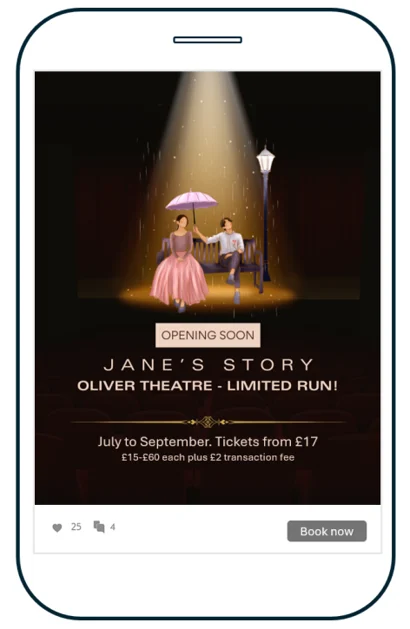
Image from CMA guidance, November 2025.
This clarity matters beyond your ticketing journey. Customers may see your pricing in several places before they ever click “Book now”: listings pages, event pages, emails, third-party promotions, billboards, and partner marketing.
A good next step for most organisations is a quick audit: where do we show prices publicly? Where do we use “from $X” language? Are we consistent across every touchpoint our audience sees?
2. Within the booking journey: Clear seat selection
Once a customer enters the online booking journey, you may need to be more specific. This is your last opportunity to disclose full pricing to ticket buyers “prior to the ticket being selected for purchase.”
At seat selection, per-ticket prices should include any per-ticket fees as a single figure, so audiences see a clear, accurate price for each ticket type.
With per-transaction fees, a clear and compliant approach is to display the per-ticket price accurately and signpost the fee clearly as a per-transaction charge. Patrons should understand that it applies – but it does not make sense for it to be forced into a per-ticket figure that cannot yet be fairly calculated. You can see an example of this on the CMA’s guidance for their “Flower Show”.
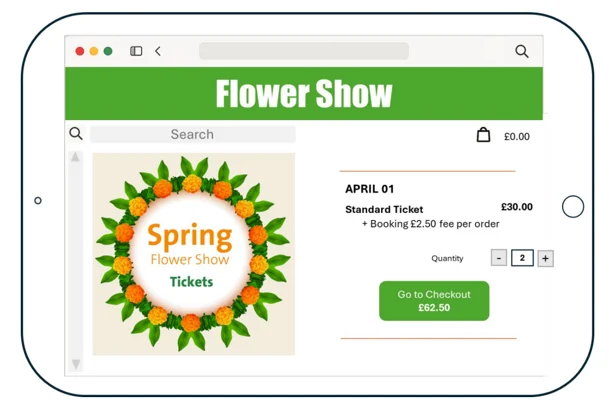
Image from CMA, November 2025.
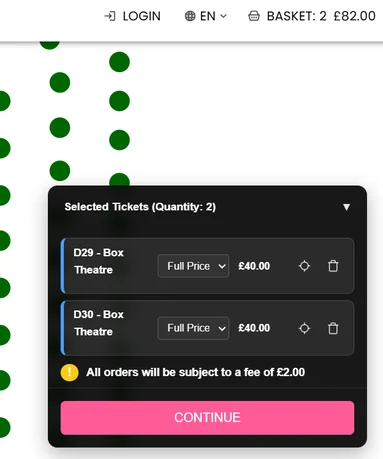
3. Cart and checkout: Be explicit, and calculate totals automatically
Once the customer has started building a cart, the ticketing system does the math for you. This is the point where per-transaction fees become concrete and the patron can see a true total.
If you’re working with a system in which transactions are completed on a different domain – often called a white-label site – you may have less control, and you’ll need to verify what steps your ticketing provider is taking to comply with new ticketing legislation.
Best practice at this stage of the purchase pathway is to:
- Make the per-transaction fee visible (clearly labelled as “per order” or “per transaction”).
- Ensure the total price is calculated automatically.
- Where possible, show a running total that includes all unavoidable charges.
This approach makes it easy for patrons to see the full amount they will pay before completing the purchase, supporting compliance while keeping the journey transparent and focused on audience trust.
4. Disclose the full ticket price from the start of each transaction
Misleading fees are prohibited. You can't lie about the fees you charge. Tell customers what's being charged and why, and how much people will pay.
We’ve all been tempted by an airline or big arena show advertising tickets for $100, only to find ourselves paying an additional $50 or $60 in service charges, processing fees, and more. This kind of price gouging is exactly what the various ticketing legislation bills set out to prevent. As US Senator Richard Blumenthal phrased it, “Airline travel, concert going, common purchases – seemingly almost everywhere – consumers are compelled to pay hidden excessive charges. Our bill will help end this price gouging – forcing full disclosure upfront and restricting abusive fees. It will mandate basic common sense fairness and transparency, which consumers rightly demand and deserve.”
While it may be tempting to focus purely on the booking journey, pricing risk often arises earlier – in advertising, marketing copy, and third-party promotions.
If customers see “$20 tickets” in marketing, but unavoidable fees are added later, that is where confusion, frustration, and complaints tend to originate.
It is also worth thinking about partners – promoters, visiting organizations, membership platforms, and third-party listings. If they advertise your prices, they need the right numbers too. Reviewing pricing communication holistically – across your own channels and those owned by your partners – is an important part of your response to ticketing legislation, and case studies like V&A Dundee show how connected systems and integrations can streamline operations while keeping data aligned.
Clearly demonstrate your refund and fee policy
Tell the truth when it comes to fee-related information that matters, like whether fees are refundable.
Many organizations charge fees for understandable reasons – contracts, commercial structures, and the practical realities of funding operations.
Ticketing legislation simply requires you to be honest and transparent about your refund information and provide refunds in full where fees are mandatory. This only applies to mandatory fees, like service charges – it’s your choice whether to refund optional charges for physical tickets, credit card payments, or similar add-ons.
However, this moment also invites a broader question. Rather than simply listing fees differently, some organizations are reconsidering whether the separation itself is necessary. Inclusive pricing – where unavoidable charges are incorporated into the headline ticket price – can simplify compliance and make audience communication far clearer. It is worth noting that this decision may require renegotiating commercial arrangements so that both the organization and its producing partners share a structure that supports a single visible price.
That is not a small shift. It involves rethinking established business practices that were once the simplest way to operate, and aligning them with a more audience-centred, long-term approach. But as scrutiny of fees increases, it is worth asking whether older structures still serve the relationship you want with your audience, and the long-term sustainability of your organization.
Final thoughts: Clearer pricing benefits everyone
At its heart, ticketing legislation is rooted in a simple idea: customers should be able to see what they will actually pay.
Per-transaction fees introduce nuance, because their impact depends on what is in the cart. But with careful handling – meaningful “invitation to purchase” pricing, accurate per-ticket figures, and transparent per-order charges – organisations can approach this confidently.
We support initiatives that improve clarity and trust in ticketing, and that help you build stronger, longer-term relationships with your audience.
Greater transparency strengthens audience relationships and supports the long-term health of the sector, creating the foundations for in-person experiences that bring people together.
State-specific ticket price transparency regulation
You can find a full list of the latest state-by-state ticketing legislation on the website of the National Conference of State Legislatures (NCSL).
While there are many common threads, specific regulations are set by bills adopted or in progress across different states, so there isn’t a consistent approach across either the US or Canada – and things are changing fast.