Are you considering the whole customer journey?
Often when companies or organisations are selling something, anything from an experience at the theatre to a plane ticket to a dress from Topshop, it’s easy to forget the process consumers go through before they get to the point of actually purchasing what you’re offering. We call consumers many different names; audiences, customers, visitors, patrons. However, we should always be thinking of them as consumers, who spend much of their time buying various products and experiences online and in person. They are experienced in their preferred way of purchasing things, and we in the arts need to make sure we fit in with the customer journey they go through when buying anything.
Thinking about buyer personas is a good way of making sure you understand the processes and steps groups of consumers can go through, before deciding to visit your organisation. These personas can give you valuable insight into your audience’s purchasing behaviour and can perhaps highlight areas for you to focus time and money on. An example of a person’s decision making process for purchasing tickets at an arts organisation is below.
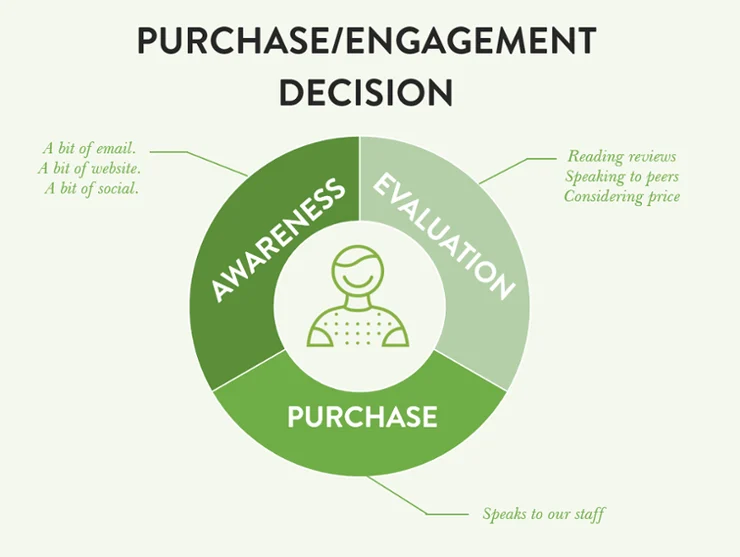
Making a customer aware of your product is the first hurdle in their purchase path. Adverts online and invites to events on social media are a couple of ways to increase your customer’s awareness. Once they know about your organisation and are interested in coming to visit you, they will do their own background research to decide if coming to see you is something they want to spend their time and money on.
The first direct point of contact is often when they purchase tickets and finally speak with your organisation. However, there’s so much going on that influences someone’s decision to attend your venue before they even get in touch with you, and that’s what everyone in the arts needs to focus on in order to make this whole process smoother.
Whilst there are many ideas on what makes a great customer journey and experience, here are some steps we think will make a big difference to your customers’ experiences as a whole, leading them to become more loyal to your organisation and ultimately increase your revenue.
1. Be where your audiences are
Your audiences aren’t planning their lives out by looking at your print brochure and reading the local paper for ideas about what to do in their spare time.
Most of your customers aren’t aware when your new season starts or that the onsale you’ve been planning for months is next week. Instead, a more commonly recognised way of planning activities such as event attendance is in „micro moments“. These are little bits of time when we use our devices in advance of purchasing something. They could be on the bus, or waiting for someone, or in front of the TV, when in a short moment we search for information. It’s at this point that we consider, plan, evaluate and decide what to do, where to go and what to spend money on. These micro-moments can be broken down into four types:
- I-want-to-go moments
- I-want-to-know moments
- I-want-to-do moments
- I-want-to-buy moments
With most sales now taking place in the moment on mobile devices, it’s ever more important to be present and in your customer’s mind during those micro moments. So test your own organisation:
- If you Google the name of your venue, have you made it easy for consumers to find out what’s going on straightaway?
- If someone were to search for “gig tickets in [your town]”, would yours be the first venue they came across?
Moments like these seem very small and insignificant but could actually be one of the most important tools you use to get customers to engage with your business. Start thinking less like a venue, and more like a consumer.
2. Be personal
Marketers talk about personalisation all the time but very few brands and companies actually do it really successfully all the time, and even fewer arts organisations. It’s not enough to write our names incorrectly on a coffee cup, and there’s a very fine line between personalising your communication with the customers to make them feel valued and overstepping the line in a way that seems too familiar and invasive. It’s all about recognising the feelings your customers have about you and reflecting that in the way you communicate with them.
A great example of this personalised communication is this email from the Bush Theatre in Hammersmith.
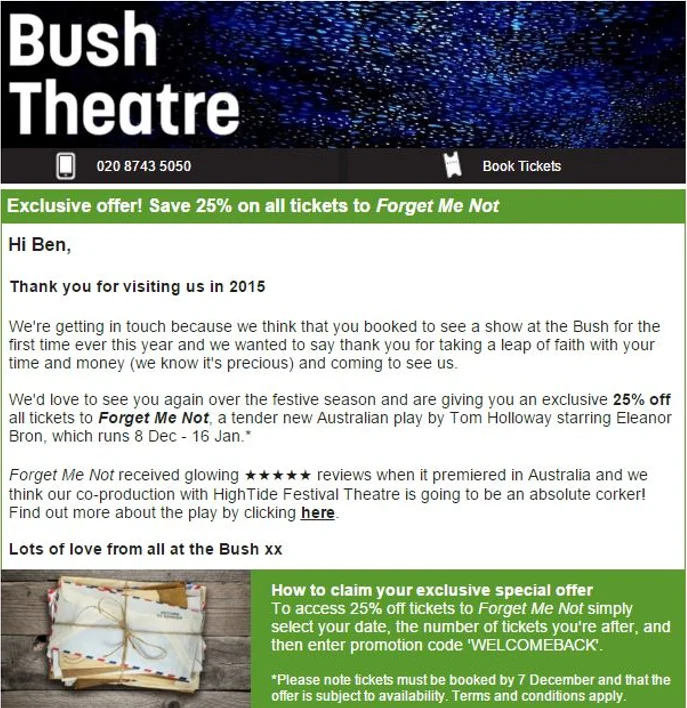
They mention at the beginning that they think I visited their venue for the first time this year, therefore recognising that even though I booked myself for the first time this year, I may have been to the venue before with someone else. They’re not making assumptions, and they’re recognising my customer journey. The copy is thoughtful and they put in an offer at the end to tempt me to book with them again.
If you can incorporate storytelling into your communication, that’s even better. An unlikely brand who does this really well is EasyJet. Like cultural organisations, they collect lots of personal data about their customers and they use it in an extremely creative way to build an engaging campaign.
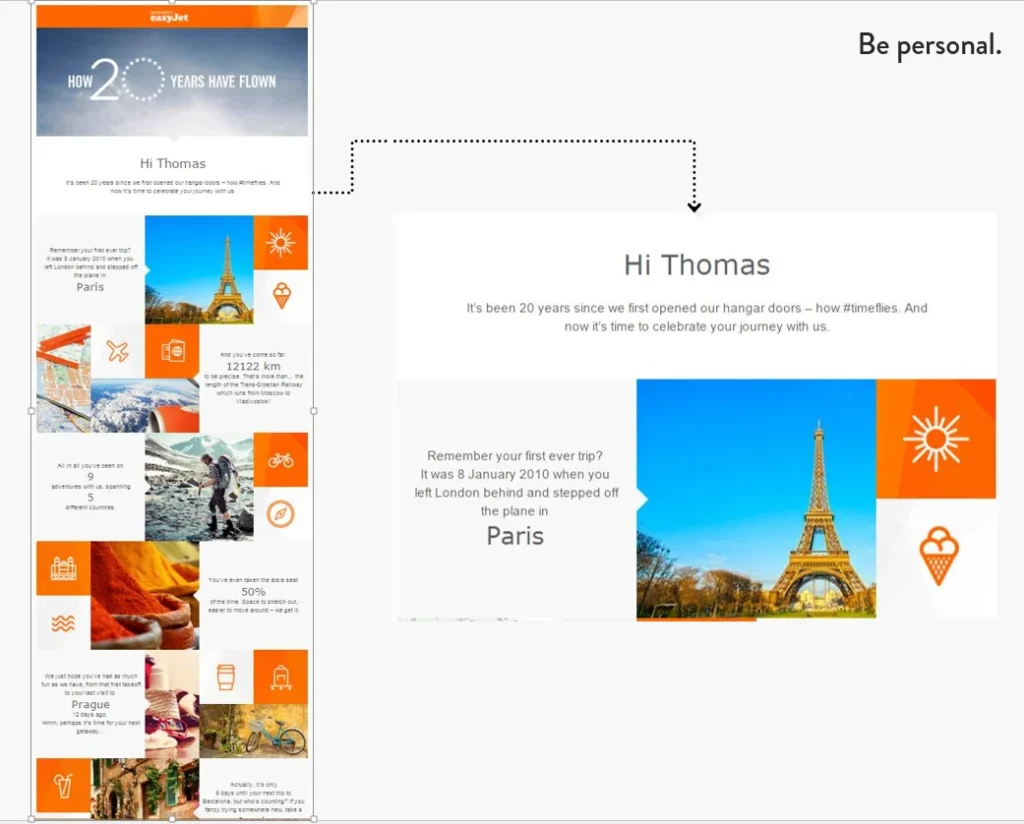
In October 2015, they used my colleague Tom’s booking history to tell a story about where he has travelled, making the story all about the places that he and the brand have gone together. They used lots of different metrics for different customers, comparing his total distance flown with the length of iconic journeys. It’s surprising and delightful, and there’s no reason the cultural sector can’t be doing the same.
Aside from providing personalisation in marketing communications, enable your people to be humans. In the arts sector, there are tons of staff on the front line; ushers, exhibition assistants, box office staff, bar staff. They’re nearly always the people that meet our customers at the end of the purchase path and the start of their experience. The sector is great at knowing how to put in a process for how these people handle complaints but we’re not so good at enabling our teams to recognise and reward our customers and add a real human, personal touch.
Pret a Manger do exactly that. All their staff have a monthly allowance of free coffees they can give to customers, entirely at their discretion. There are no rules and staff are able to give out a drink to customer who “make an impression” upon them. It’s easy to be cynical and say that Pret is a huge company that can afford to do something like this, but imagine how great your staff would feel if they had the power to do something like that. Great customer service is very valuable, so don’t underestimate the difference implementing something like this could make.
Good service triggers the same cerebral reactions as feeling loved.

3. Keep it social
We’re no longer at the stage where we’re wondering if Facebook and Twitter are actually a serious influence in consumer behaviour. They are. Your social channels are as important as your box office phone number and are probably more important than your season brochure. The best users of social in the cultural space use social channels as a two way communication channel and not just a broadcast version of their print.
To learn more about ways you can improve your use of social media, read Colleen Dilenschneider’s blog. She’s a straight talking, pragmatic marketer who understands the importance of social media and how it affects the cultural sector.
Assuming you’re already on top of the usual channels for social, you should be focusing on social channels that are emerging as influential for the cultural sector, like Tripadvisor. Like it or not, Trip Advisor operates in the cultural space. In other industries, if handled in the wrong way Trip Advisor can be very damaging to income. However, rather than fearing it, we should all be embracing it as a very powerful touchpoint. If there are people reading about your organisation on Tripadvisor, they’re thinking about coming to see you. You can be more certain of this than if people are visiting any of your other channels.
<div><span style="font-size: clamp(14px, -1.456px + 0.875rem + 0.455vw, 18px);">44% of Tripadvisor visitors read 1-3 reviews before engaging with an attraction & 1 in 4 of the population regularly use Tripadvisor when planning their free time.</span></div>
These stats show the huge impact it can have if you manage it correctly. Take ownership of your brand page and make sure you are listening to what people are saying. If you don’t, someone else will be writing reviews of you, your work and their experiences and you won’t be able to engage with them. Embedding Tripadvisor on your own website is also a great way to be transparent and encourage user interaction. Not to mention that it’s free and promotes trust with your customers.
4. Join up your customers‘ journeys
Collaborative marketing means thinking about how you can extend your customer journey to affect the other things that your customers might be thinking about when they interact with you. If your visitors are planning a trip to and from your venue, how can you help them with the journey?
One option could be to join up with public transport networks. You can become an affiliate and place their ticket finder directly on your website. Not only does that make life easier for your customers to plan their whole experience in one place, but many companies will pay you every time someone goes on to book with them. Other companies that do this are taxi companies, hotels, and carparks. Recognise that your customers‘ experience exists beyond just inside your building.
Make sure you marry everything else you’re doing with your social presence. People love to talk about experiences they’ve just had on social, so make sure you’re capitalising on that peak feeling and create a super easy way for your audiences to engage with you immediately after the event. You can do this quite simply by providing easy links to social in your post show emails or just by prompting people on the way out that now is the time to talk about it
Start building connected customer journeys today
There’s so much you can do to make your customers‘ journeys as easy and as streamlined as possible.
- Think about personas. We all have an idea of who our customers and audiences are, but it’s time to reframe that in an entirely new way and understand how people are interacting with us on their customer journey. Put yourself in the shoes of your audience and offer the right value proposition for everyone you’re trying to reach.
- Be where your audiences are. Map out every point of contact your audiences already have with you and find out which points of contact you’re missing. Ask them how they plan their visits to you.
- Be personal. Be authentic and human in your communication. Use your personas as a way of defining what kind of communication style is appropriate to your different audiences
- Be social. Think outside the box when it comes to your social media presence. It’s about more than just Facebook and Instagram these days.
- Join up your journeys. Allow your customers to plan their whole experience from your own online presence. Make life easy!