Think back to last season. Chances are a good portion of your marketing budget and staff time went toward attracting new patrons. When it comes to designing and prioritising arts marketing campaigns, organisations often focus on first-time audiences and new ticket buyers – and they are good at it.
But what happens to those people after they attend their first season, once they’re no longer new? They are already engaged and listening. So why do so many organisations dedicate fewer resources to getting those audience members to return, attend more performances, and build deeper loyalty over time?
In 2018, 56% of patrons were first-timers, but only 31% of patrons who booked the previous year returned the following season. This varied by genre, as the chart below shows – but the approximate proportion of first-time audience members has held steady over many years.
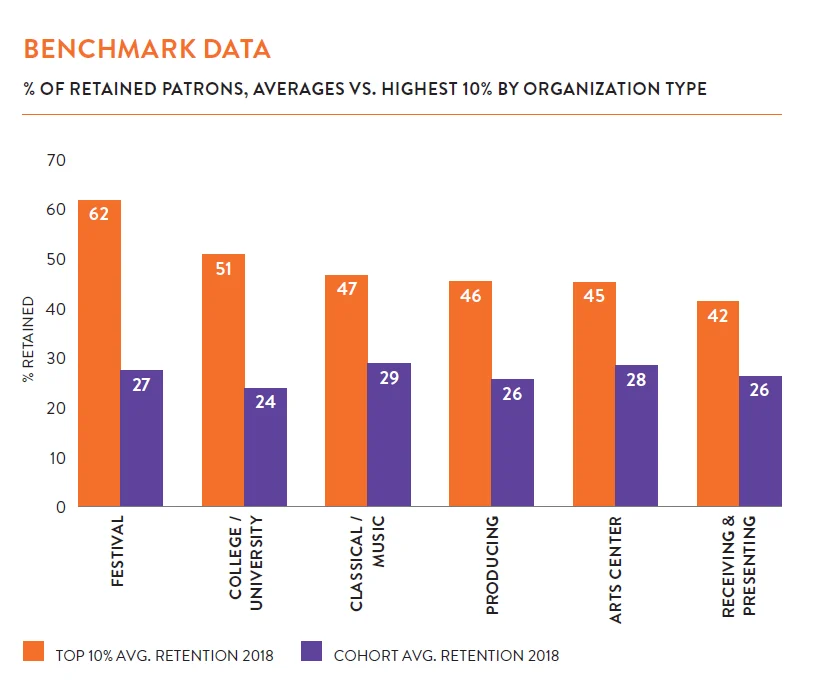
Considering that every first-time audience member from year 1 now knows a little about what the organisation has to offer, why is it so difficult to get them to come back in year 2, or beyond?
This blog contains ideas for successful arts marketing campaigns designed to drive up retention, informed by organisations that lead the pack on reattendance. By developing a clear understanding of the patron loyalty stages, tracking the right behavioural information, and using it to craft targeted communications strategies, arts marketers can drive change at their organisation and increase ROI from their retention campaigns.
Define the stages of audience loyalty
Organisations that prioritise retention have discovered successful arts marketing campaign strategies that significantly outperform the average, according to a study of 350 arts organisations in the US, Canada, and the UK. When surveyed, these successful organisations said their retention work starts from a common place: defining the stages of audience loyalty.
What that looks like varies for each organisation, but they all share the same intent: to define a clear framework, shared by the every team, to help plan, track, and measure the impact of marketing campaigns.
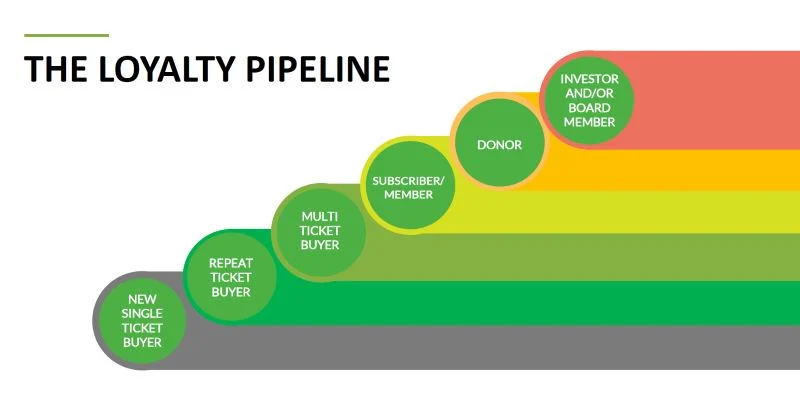
Here’s one example that outlines loyalty in the following stages:
New single ticket buyer: First-time audience members who have completed their first interaction with the organisation.
Repeat ticket buyer: Customers who have made a second visit.
Multi-ticket buyers: Audience members who are starting to become invested in the organisation and buy multiple tickets for themselves and others.
Subscriber/member: Patrons who have committed to an organisation’s offer by buying into their loyalty programme, whether that’s a subscription, membership, or multibuy package.
Donor: Audience members who have taken the next step to support the organisation via charitable giving (and the range of donor stages involved in that).
Investor and/or board member: Regular attenders who have formed a deep relationship with the organisation, and now support its strategic management as an investor or board member.
As people move through the loyalty pipeline, the organisation’s relationships to those individuals grows deeper and the amount of revenue from each patron grows. At the same time, the cost for the organisation to retain those patrons decreases: they are already invested, and that established loyalty gives them an intrinsic drive to support the organisation.
The data that arts marketers should track
Defined loyalty stages are a useful outline, but the next step in designing strategic arts marketing campaigns is to pinpoint the exact behaviours that map audience members to each loyalty stage.
Tracking and analysing customer data lays the groundwork for creating a segmented CRM strategy to communicate with patrons and guide them through the loyalty pipeline.
Arts marketers should track data that goes beyond demographics; avoiding generalisations or assumptions about people’s interests, motivators, or spending power. Instead, you should find ways to track patrons’ actual behaviours, creating a genuine, connected picture of each individual’s interests and needs.
Arts marketers should track:
- Which events audience members have attended, and when
- Whether they have joined special events like post-show talks or classes
- Patrons’ engagement with loyalty programmes like season passes or memberships
- Giving history, from low-level donations to capital campaigns
- Purchases of merchandise, catering, or other add-ons
- Takeup of discounts or promotions
- Engagement with email or digital marketing campaigns
While it might not be possible to track all of these details, working to capture more context on how patrons interact with the organisation is key to successful pipeline segmentation based on similar behaviours. This, paired with the organisation’s loyalty framework, is key to building meaningfuol arts marketing campaigns that engage each individual and work to move them to the next loyalty level. It also lays the groundwork for identifying the behaviours that help nurture a new ticket buyer into a repeat buyer.
Marketers should report on each group to understand what influences them to convert to a higher loyalty level – for example, whether attending specific events or receiving certain communications increase the likelihood of retention.
Techniques for segmentation
With an understanding of their organisation’s loyalty stages and the behaviours that link patrons to those stages, arts marketers can execute their segmentation strategy and create a communications plan for engaging those patrons.
In order to capture and segment on all of the necessary patron behaviour details, arts organisations should work out of a single database. Having a single customer view where all of a patrons’ actions are recorded in once place allows arts organisation to create granular, tailored massaging. It also allows organisations to track their campaigns’ success.
For example, an organisation might have a season goal to move more multi-ticket buyers into the member category. They decide to create a campaign targeted toward multi-ticket buyers encouraging them to try out a membership by offering them a discount on their first membership. To segment these patrons, the organisation would need to be able to record which shows patrons had attended throughout their history with the organisation and whether they had purchased a membership before. It also would be helpful to know whether they had ever donated, because those patrons might call for different messaging.
After segmenting out that patron group and developing fitting messaging for them, the organisation can send the campaign along its way. It would then want to run reports on that patron group to see how many converted to members throughout a given period. From there, they would want to segment (A) their new members and (B) people in the targeted group who did not redeem the membership offer. For group A, the organisation could develop messages that thank and later prompt them to buy a full membership next season. For group B, arts marketers could resend the offer email to see if the reminder prompts them to act. Patrons who are still not responsive, can be re-categorized as single ticket buyers.
To do this, arts organisations need to be able to track purchases across ticketing, memberships and donations as well as offer redemption, and all of these behaviours need to dynamically update into the same record with every new patron transaction. They also need to track how patrons respond to email marketing and to run reports on these behaviours.
Having a single customer view allows for effective segmentation because it takes the full range of patrons’ behaviour into account and helps organisations respond to them with the appropriate messaging, creating the best chance possible for them to engage and build loyalty.
How successful organisations leverage segmentation
Because loyalty can look for different from organisation to organisation, there is no one way to build a successful retention strategy. organisations can channel the building blocks of defining loyalty stages, tracking patron data and segmenting into finding what approaches work for them and their patrons.
Here is how one organisation did exactly that: Ensemble Theatre in Cincinnati, OH started their retention efforts when they opened in 1986 to compel patrons to return to their Over-the-Rhine neighborhood. Now, they have expanded their retention focus to accommodate the digital-driven ways their current audiences book tickets and donate.
Ensemble Theatre defined their loyalty stages by developing a patron loyalty map to serve as a visual tracker for the staff as they work to move audience members from ticket buyers to reattenders and then subscribers. They collect a full range of patron information and segment patrons based on their attendance in a given time frame. They encourage reattendance with targeted, generous, and timely offers to upcoming shows. They then move patrons who have attended multiple times up the loyalty ladder and repeat the process, this time targeting them as potential subscribers.
Having the ability to track all of their patrons’ behaviours in a single view has been central to creating this digital-first approach to loyalty, said Jocelyn Meyer, Ensemble Theatre’s Director of Marketing and Communications.
“The vast majority of our strategies surrounding audience retention have been made possible by using technology which allows us to segment, track and action our plans. An integrated email platform has had a major impact on audience loyalty,” Meyer said.