Park Theatre has always been proud of what it is: a neighbourhood theatre with a global ambition. Unlike many London venues of a similar size, it doesn’t receive regular government or Arts Council funding. So the gap between what a ticket costs and what a show actually costs to stage has always been significant.
A ticket price that doesn’t tell the whole story
Before this project, around 3% of Park Theatre customers were voluntarily paying more than the advertised ticket cost, through donations. Not because their audiences didn’t care, but because it wasn’t clear why theatre donations mattered, and there was no easy way to give.
“If you’re not educating people, people just come in and pay as little as they want, because everyone wants a deal. There is a big piece of education that has to be done.”Jez Bond, Artistic Director
Park Theatre (as quoted in The Stage)

Park Theatre didn’t want to raise prices across the board. That risked pushing out the audiences who wouldn’t be able to afford it. Instead, they wanted to give people who could pay more the option to do so.
When some friction can be a good thing
Most booking journeys are designed to remove steps, not add them. Fewer clicks, fewer screens, fewer chances for someone to give up halfway through.
This brief went against that instinct. Explaining how funding within the arts operates would require a carefully timed moment during the booking process. This meant adding something new into the journey rather than (our usual process of) stripping stages away.
“I wasn’t sure how customers would react to something which pushes them to pay attention to donation messaging and interact more than they usually would with an in-basket donation."Dawn James, Sales & Marketing Director
Park Theatre
The Park Theatre team were understandably nervous. But a bold challenge about the realities of theatre funding needed a bold way of posing it. The brief became less about minimising friction everywhere, and more about being deliberate with it. Making the donation conversation impossible to miss, while making it just as easy to politely decline.
Finding the solution
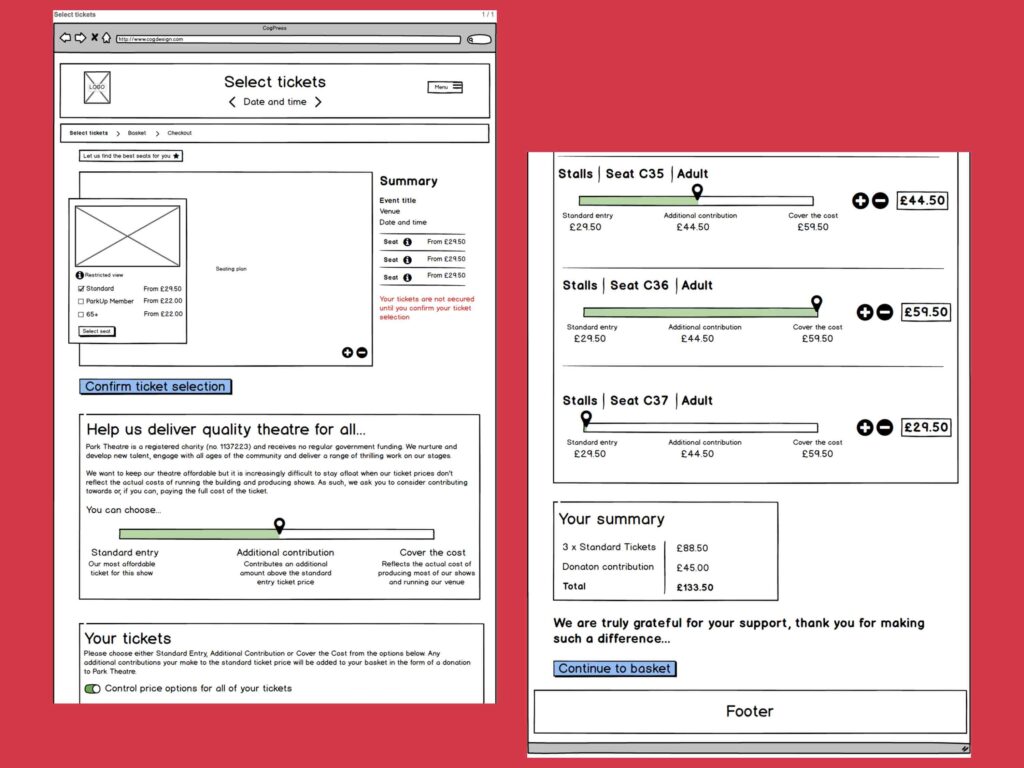
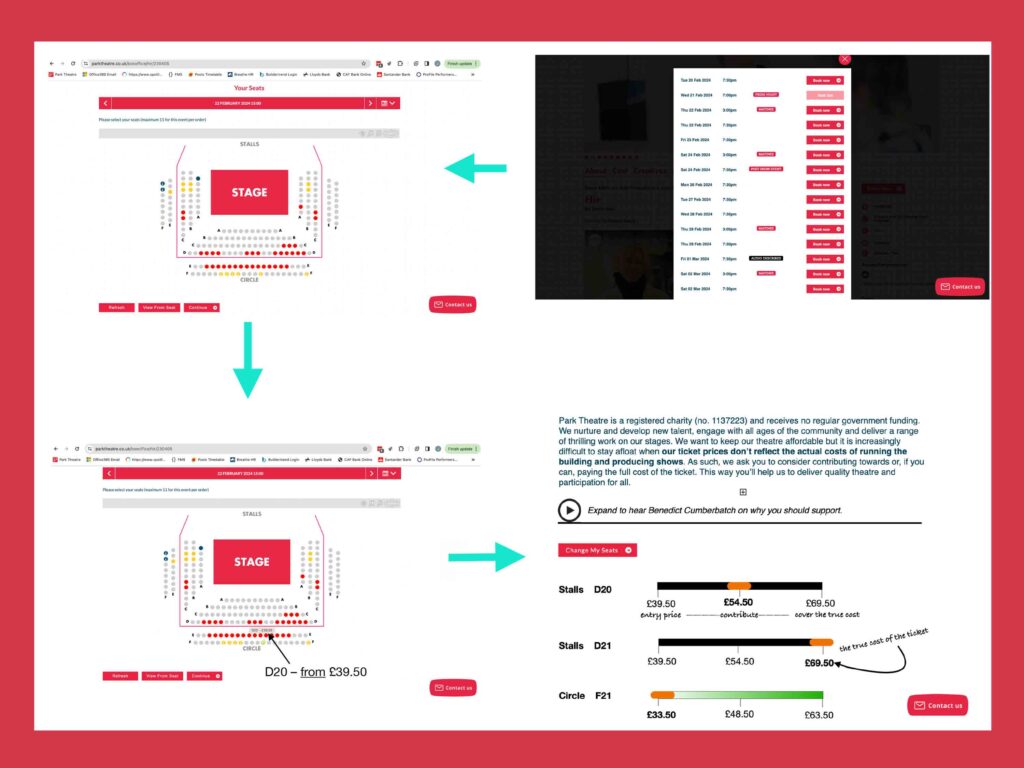
We were already tasked with building a new, fully Spektrix-integrated website for Park Theatre, which meant this new feature could be built directly into the purchase experience from the start. Using the Spektrix API, we could calculate a “cover the cost” figure for any ticket the moment someone selected their seat, and let the customer decide how much extra they wanted to put towards it.
The real challenge was curating the overall experience we wanted the user to have when interacting with this new function. A straightforward form asking for a donation amount would have basically done the job, but it’s a fairly typical approach that hadn’t worked for Park Theatre in the past.
Donating and giving extra should feel good. We wanted the physical act of choosing an amount to feel as warm and human as the reason behind it. So we explored a lot of options: different formats, different interactions, different ways of making a page about money feel less like a transaction and more like a small moment of joy.
Finding that moment of joy
The final chosen idea starts on the landing screen, setting out the context and motivation for the donation ask to come. It explains, plainly, why ticket prices don’t cover the full cost of a production, and what Park Theatre is hoping audiences will consider at the next stage.
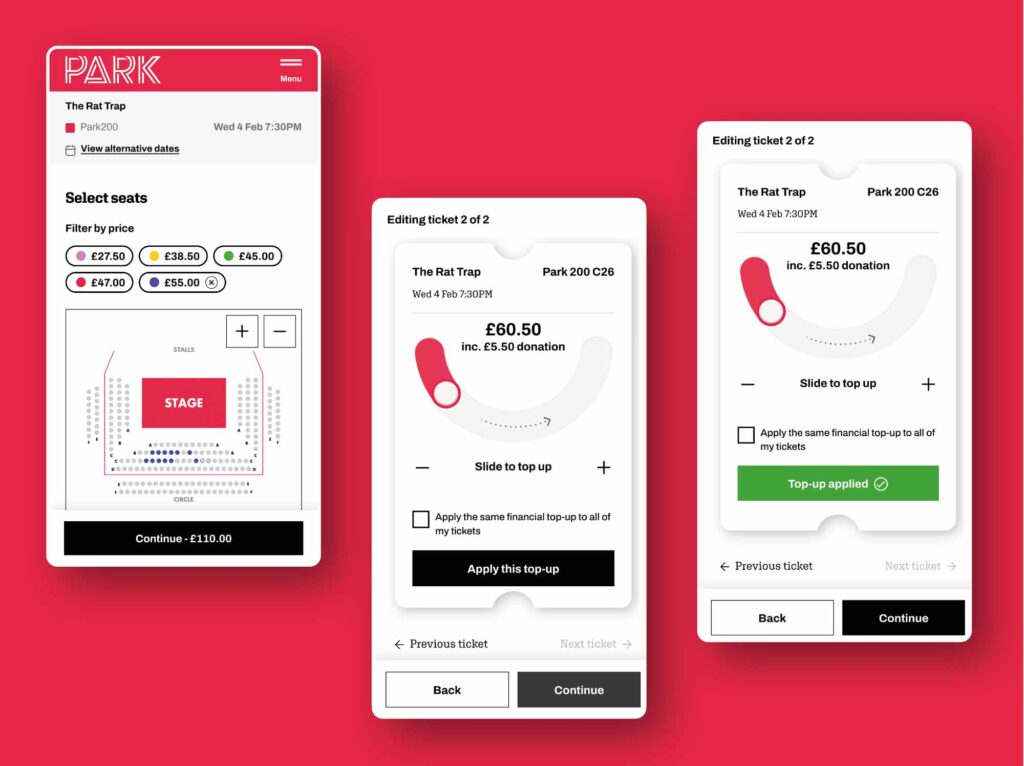
From there, users reach the ticket top-up stage itself. They can see exactly where their chosen ticket price sits against the true cost of that seat, and a smiley face slider lets them move that figure up or down. A user can choose to cover the full cost, and a small animated heart and a thank-you message appear, a tiny touch to mark the moment rather than letting it pass as just another step in the checkout.
We built in heaps of practical features too. Customers booking multiple seats can apply the same donation amount across their whole order in one go, rather than repeating the process ticket by ticket. And at every point, it’s just as easy to slide the amount down to zero and carry on through to payment. The ask has to be prominent but should never be a barrier.
Increased theatre donations: The results speak for themselves
Within its first year, the new ticket top-up feature has processed over £70k in theatre donations, delivering a 344% return on the cost of developing it. That’s not a one-off spike. It reflects a meaningful shift in how many customers are choosing to give something extra as part of a booking.
“I was fully prepared for a tidal wave of complaints from customers when we launched, which never materialised. The success of the ‘slider’ has been beyond anything we could have imagined, which the donation figures show, and the vast majority of customers use the tool with ease to donate.”Dawn James
The data shows no noticeable rise in drop-off at the point where the donation ask appears, despite this additional step in the booking process. Mobile sales conversions have remained strong, which mattered given how much of Park Theatre’s bookings occur on a phone.
The great news is that a growing number of Park Theatre’s audiences are now actively choosing to support the organisation every time they book because they understand why it matters and are given a genuinely easy way to act on it.
“As an industry, we need to think big to address the issues in fundraising, bring on great partners including Cog, and have faith our customers will come on board for that journey.”Dawn James
Cog Design and Park Theatre’s partnership on this project isn’t finished. We’re continuing to work together to refine the feature, respond to feedback, and keep sharpening the ask so it stays effective.
The early results are incredibly positive; it’s clear that Park Theatre are effectively building on their relationships with audiences and shifting the conversation on funding within the arts.
“I absolutely would recommend that other theatres do it”Jez Bond