Arts Council England (ACE) opens applications for its 2028–2033 funding round on Tuesday 20 October 2026, with applications closing on Tuesday 15 December. That means theatres, venues, museums, and libraries across England are preparing data and stories to showcase their impact, whether they’re existing National Portfolio Organisations or new applicants.
We know that there will be many Spektrix users among those applicants, and you have told us how much you value clear data on your reach and impact to support Arts Council reporting. So when the latest funding round was announced, we gathered team members to identify the most relevant reports, prepare clear guidance, and help you find the support you need to put your strongest case forward.
Bryony Bell is Head of Content & Campaigns at Spektrix, and Vice Chair of the Arts Marketing Association. She and other AMA board members met in early October to review the latest Arts Council guidance and plan the AMA’s application.
Victoria O’Brien leads Client Success management at Spektrix, with past experience as a fundraising specialist and data analyst at the Roundhouse, Camden and the National Theatre. She works closely with Spektrix users across the UK to guide data-led strategy and long-term growth.
Practical support for your NPO application
Use this section to plan your application, make the most of the support available, and follow our guidance to find and interpret data in your CRM.
Many organisations are offering webinars and support options along the way, including a Spektrix roundtable for senior fundraisers on Friday 16 October. You can find links to other organisations towards the end of this article.
How to find NPO data in Spektrix
Spektrix gives you access to detailed data relating to attendance, participation, and revenue. This information will help you plan your application and evidence your impact.
If you use a different system, this section can still help you identify the questions to answer using your own database.
Geographical reach
ACE is prioritising investment and delivery in places with historically lower investment, opportunity, or engagement, with a particular focus on England’s 81 Culture Priority Places. The DCMS list combines existing Arts Council Priority Places with additional areas identified using deprivation, community need, cultural participation, and historic funding data.
Even if your organisation isn’t based in a Culture Priority Place, you may attract audience members, visitors, or participants who live in one.
What you might want to know:
- Which postcode districts do most of our bookers live in?
- What percentage of our unique bookers live in Culture Priority Places?
You can build a simple custom report from Spektrix to give you both of these answers.
- Follow the step-by-step guide on the Spektrix Community
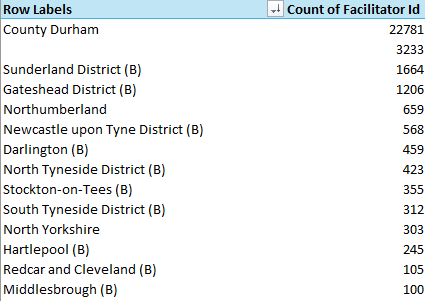
The report lists the postcode districts in which your audiences live, and the number of customers living in each district who bought tickets within your chosen timeframe. You can filter it further by any criteria recorded in Spektrix – including date range, programme strand, ticket type, offer, donation, or community engagement.
The report you receive will look like:
How does Spektrix identify District?
Culture Priority Places are defined using postcode districts.
In 2024 we integrated Ordnance Survey postcode data into Spektrix. Since then, whenever a new postcode is added, related data for District, Ward, and Admin Area is also pulled into your system.
Until this week, you may have seen gaps in your District and Ward data where postcodes were added to your system before the integration.
We have now backfilled all District data to match postcodes that already exist in your system. This data will appear in reports from Wednesday 14 October to support your NPO applications and other geographical reporting.
Income resilience
Your NPO application will need to demonstrate financial viability. Historical ticketing and fundraising data held in Spektrix can help you distinguish between earned income, donations, sponsorship, and other revenue; track changes over time; and identify revenue from specific activities or programme strands.
Every organisation is likely to need slightly different information here. If in doubt, we recommend:
- Start with the Payments & Activities Report in your Spektrix system. This shows all payments received for a specific period, broken down by payment type and revenue strand e.g. commissions, ticket sales, merchandise, donations, and memberships.
- You may also want to run the Payments & Activities Report (detailed). This also looks at payments received in a set timeframe, but breaks them down by event or activity as well as gross, VAT, and net value.
- If you need additional information, explore the full range of Accounting and Payments reports that are included in your system as standard, or reach out for support to find the detail you need.
Audience engagement
You may wish to include evidence of your reach or retention, showing how effectively you have attracted new audiences, retained existing visitors, or increased the frequency of arts engagement.
Use standard reports to find these figures for your whole audience, or filter them by specific criteria. These might include District or postcode data to identify first-time bookers from Culture Priority Places; age group, demographic, or segment data if you collect it; or engagement with a specific offer, event, or activity.
Follow the steps in our Understanding Audience Loyalty article to learn:
- The percentage of first-time bookers in a year
- Audience retention across multiple years
- Audience reattendance within a year
Benchmarks can help you interpret your results, but your organisation’s context matters. For example, first-time visitor proportions may be higher in urban areas with more cultural choice, while reattendance patterns may differ between receiving and producing venues, galleries, and community arts centres. Our recent report, Understanding Every Individual to Engage and Grow Your Audience, offers additional context and international research.
Audience data benchmarks
England benchmarks for retention and reattendance, using 2025 booking data. The first-time booker benchmark covers the UK and Ireland.
First-time bookers
- In the UK and Ireland, 49% of ticket buyers were first-time bookers at a specific venue.
We don’t have a figure specific to England, but Indigo Ltd provide some interesting breakdowns for London, Yorkshire, and the North East.
Audience retention
What proportion of bookers from earlier years booked again in 2025?
- 30% of audiences who booked in 2024 returned in 2025 (one-year retention)
- 16.7% of audiences who were first-time bookers in 2024 returned in 2025
- 25% of audiences who booked in 2023 returned in 2025 (two-year retention)
- 13.6% of audiences who were first-time bookers in 2023 returned in 2025
- 22.5% of audiences who booked in 2022 returned in 2025 (three-year retention)
- 12.6% of audiences who were first-time bookers in 2022 returned in 2025.
Audience reattendance
How many distinct events did each ticket buyer book for in 2025?
- 79.8% booked for one event in 2025
- 11.3% booked for two events
- 8.4% booked for three or more events
Tell compelling stories
In the past, organisations applying for NPO funding have been able to attach documents including reports, case studies, and impact stories. This year, everything has to be included in written answers, many of them limited to 3,000 or 5,000 characters. That’s about 600–1,000 words, or one to two sides of A4.
We often have to help teams understand the benefits of Spektrix in a short space of time, in an email, tender document, or presentation. So we asked members of our team for their top tips for telling compelling stories.
While the detailed data in your CRM should inform your narrative, the format and character limits mean you won’t be able to tell every story. Before you write a word, take time to choose carefully and explore different ways to evidence your impact.
- Start with the question: what does your assessor need to understand? You may have amazing quotes and stories from people who have benefited from your work – but if they don’t fit your narrative, they’re superfluous here. Find a space on your website or social channels to share them instead.
- Explore different ways to evidence impact. Sometimes aggregate data tells the strongest story. Elsewhere, a testimonial or short story from an individual may be more persuasive.
- If it feels difficult to fit a proof point into your narrative, it may not belong there. Start by collecting all the evidence you can find, and reduce the list as your application takes shape.
- Trim, and trim again. Use plain English and make each point clearly. Cut unnecessary words without losing meaning; if the answer is still too long, simplify its structure or focus. Ask colleagues to review each piece of evidence, and read the answer aloud to check that it flows.
- Use bullets and headings. It’s difficult to read two pages without any breaks. Help your assessor out, strengthen your story, and reduce word count by using clear headers, bullets, and lists where the format allows.
- Arts Council England allows applicants to use generative AI to prepare their applications. AI tools can help you challenge, condense, and clarify your writing, while you retain full control of its accuracy, quality, and content.
Sector-wide support for NPO applicants
Spektrix isn’t the only organisation offering support over the next few months. Explore the resources available to you, connect with colleagues, and remember you’re not alone.
Understand the wider context
Hannah Thomas has published a detailed application guide, including 12 recommendations for stronger applications, through Alira Arts.
Souter Point also compare this year’s process to previous application rounds, exploring the shift toward organisational purpose, excellence, and evidence of impact.
The Museums Association has published a reflection on the new areas of focus for museums, including collections stewardship, public value, and business transformation.
In The Stage, Lyn Gardner explores the challenge facing ACE as it selects its next portfolio and fulfils its mission and ambition.
Theo Bosanquet in Arts Professional focuses on the differences between this year’s NPO round and past applications.
Connect with other applicants
Join the conversation on the Spektrix Community. It’s free for all Spektrix users, and there’s a network of arts and culture professionals ready to share advice, support, and morale.
People Make It Work have established Everyone’s NPO Club, an online space for everyone making, or thinking about, an application. Fortnightly gatherings run until January and membership is a one-off cost of £500 for your organisation.
No Stone Unturned Fundraising is offering a dedicated NPO support programme, including a Facebook community, Q&A, co-working sessions, and strategic reviews, with support ranging from free to paid tiers.
Practical application support
Arts Council England is running a series of webinars for new NPO applicants, current NPOs, organisations considering applications for £1 million or more, and alumni of the Diversity Development Programme. They are free of charge and repeat in October and November.
Community Foundation North East is offering an introductory session for cultural organisations considering applying. Led by Hannah Keville, this takes place on Thursday 15 October.
Hannah Keville led a similar session for the Contemporary Visual Arts Network, East and West Midlands. That has taken place but her presentation slides are available.
Indigo Ltd has developed an NPO Readiness Healthcheck, a free, 2-minute self-assessment to help you identify gaps in your data and narrative. Indigo also offer paid consultancy to help you fill those gaps before December.
Baker Richards invites organisations to strengthen their NPO applications using evidence in the Spektrix-integrated Advantage Dashboard.
Know of other organisations offering support? Let us know so we can keep this guidance useful and up to date.
Need more support? If you’re using Spektrix, we can help you access and interpret data in your CRM system and explore new approaches to audience engagement that might support your future plans.