Discover how to apply a content marketing strategy in performance arts marketing to deepen audience engagement on and beyond event days.
Years ago, content marketing may have felt like a buzzword relegated to the worlds of tech and e-commerce. Now it is a crucial part of any marketing strategy — and yes, that includes your performance arts marketing, where a strong content marketing strategy can turn occasional bookers into a loyal audience.
What exactly are we talking about when we say “content marketing”? The Content Marketing Institute defines it as:
Content marketing is a strategic marketing approach focused on creating and distributing valuable, relevant, and consistent content to attract and retain a clearly defined audience — and, ultimately, to drive profitable customer action.

We love this definition because, particularly in the context of performance arts marketing, that emphasis on a clearly defined audience is key to effective audience segmentation and long-term audience relationships.
What a good content marketing strategy looks like in performance arts marketing
Good content marketing is not about the hard sell, but about providing people with content that is genuinely interesting, shareable, and attention-grabbing. This approach is why food brands like Whole Foods have full recipe libraries on their site, why Spotify produces Spotify Wrapped at the end of each year, and why technology companies like ours create educational articles like this one.
Not all audience members are engaged by the same types of content. Many arts organisations use the blog section of their website simply to share news and updates, which is a great starting point. However, that approach usually speaks to just one segment of your audience: people who are already enthusiastic supporters of your organisation.
A strategic content marketing strategy can help you reach those other audience segments and begin building relationships with people who are not yet regular attendees. It can include a variety of messaging, formats, and channels — not just blog posts, but also videos, podcasts, and downloadable multimedia that you can promote across your email campaigns, social media, and website.
Let’s unpack the “why” and “how” of content marketing strategy with some excellent examples from your fellow arts organisations, and think about how to connect those tactics back to your wider marketing strategy.
Why use a content strategy in performance arts marketing?
In the arts, where you have rich stories, unique experiences, and compelling creative work to draw on, arts marketers are in a particularly strong position to use content marketing strategies to their advantage.
Yet you may be asking yourself why you should put so much effort into creating content that does not immediately lead people to a booking page. A long-term content marketing strategy can support your wider performance arts marketing goals and:
Give your audience a great reason to follow you
Nobody subscribes to an email newsletter or a social media account because they only want to see ticket or donation solicitations. They follow because they want to be informed and entertained. Once you have hooked people in with valuable, engaging content, they will be actively paying attention to your organisation — ultimately boosting the impact of any ticket sale or fundraising call to action that comes through the mix.
Build a community around your audience
A steady stream of content that helps your audience members feel connected to your organisation is a powerful way to build audience engagement over time. It gives audience members an opportunity to keep your organisation in their hearts and minds, even if it has been a while since they attended an event, leaving the door open for them to return.
Boost your organisation’s authority and reputation
Content is a fantastic way to get your name out there and to share your expertise, from production know-how to all the research you have put into your events’ themes. The more relevant, high-quality content you produce, the more you can place your organisation in the conversation as a trusted source.
Directly contribute to your mission
Your organisation likely exists because you care deeply about reaching people through art and in-person experiences. Just as you educate and inspire your audience in your spaces, you can continue that vital work digitally through your content marketing.
Keeping these capabilities in mind can help you shape your performance arts marketing goals and decide where content marketing will make the biggest difference.
Content marketing examples from performance arts organisations
Performance arts marketing content can come in all shapes and sizes, and there is no one-size-fits-all approach that works for every organisation or audience. Use these great examples to spark ideas about how you might power up your own content marketing strategy and connect it back to your broader audience engagement plans.
Featuring a variety of content: “Read, Watch & Listen” from the Barbican
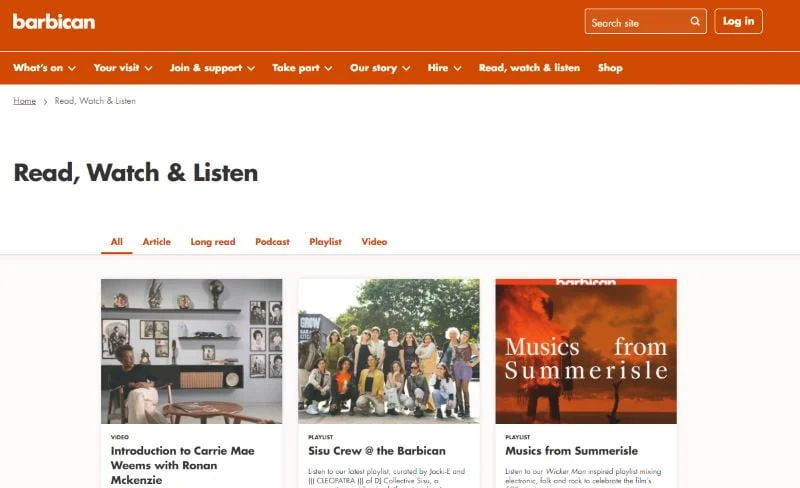
This “Read, Watch & Listen” page from the Barbican Centre in London, Europe’s largest arts centre, is the first example we wanted to highlight because it demonstrates the breadth of content that you can create as part of your content marketing strategy. As seen in the screenshot above, the Barbican produces a wide array of articles, long reads, podcasts, playlists, and videos — and the way they have organised them on their site is user-friendly and inspiring. Each type of content provides something unique, from exploring the lives of artists to building anticipation for events to taking you deep into the creative process.
We particularly love the stroke of creativity in sharing playlists to go with their events, such as their Music from Summerisle playlist, as well as playlists curated by composers. The best part is that their content strategy clearly works in service of their mission to “inspire more people to discover and love the arts.”
Welcoming new audience members: “New to opera?” from Opera North
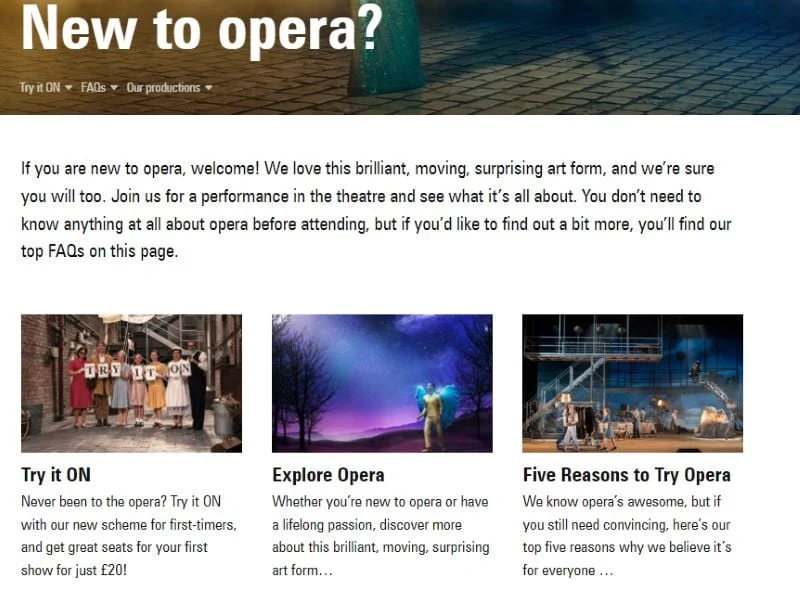
Our next example comes from Opera North, an acclaimed producing and touring opera company based in the north of England. Right at the top of their website menu is a button that says “New to opera?” which takes you to this marvellous landing page — a destination made for any first-time opera-goer. Here, they have created a lot of great content to help answer FAQs, dive into the history of opera, dispel misconceptions, and make a clear case for how great opera can be.
This is a powerful way to open their doors to a larger and more diverse audience — and it is not just opera organisations who could employ this tactic. An immersive theatre experience, for instance, could similarly take the opportunity to introduce newcomers to the concept, or a dance company could introduce new audiences to the traditions and history of their style.
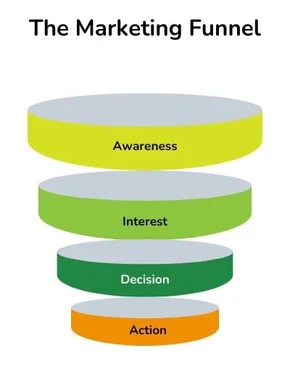
The content on this page also provides a fantastic example of how you can use top-of-funnel content and middle-of-funnel content — terms that refer to which stage readers are at in the sales journey. Top-of-funnel content and middle-of-funnel content are designed for building awareness and interest. The target audience is looking for information about a topic related to your brand and not necessarily looking to purchase something. By contrast, someone who is already convinced they want to go to the opera and is in the process of deciding which production to attend would be more interested in bottom-of-funnel content.
Take Opera North’s “Five reasons to give opera a go” blog post. It might appear in a Google search for somebody researching whether they should try opera — or be shared directly by someone trying to convince a friend to accompany them to an event. This hypothetical reader may not have heard of Opera North until now, and this post will start to answer some of their concerns. From there, the reader might decide to subscribe to updates or simply keep Opera North in mind when they are ready to buy tickets. This is a great way to kick off a trusted relationship with a potential audience member.
Downloadable lead magnets: Lesson plans from Santa Cruz Shakespeare
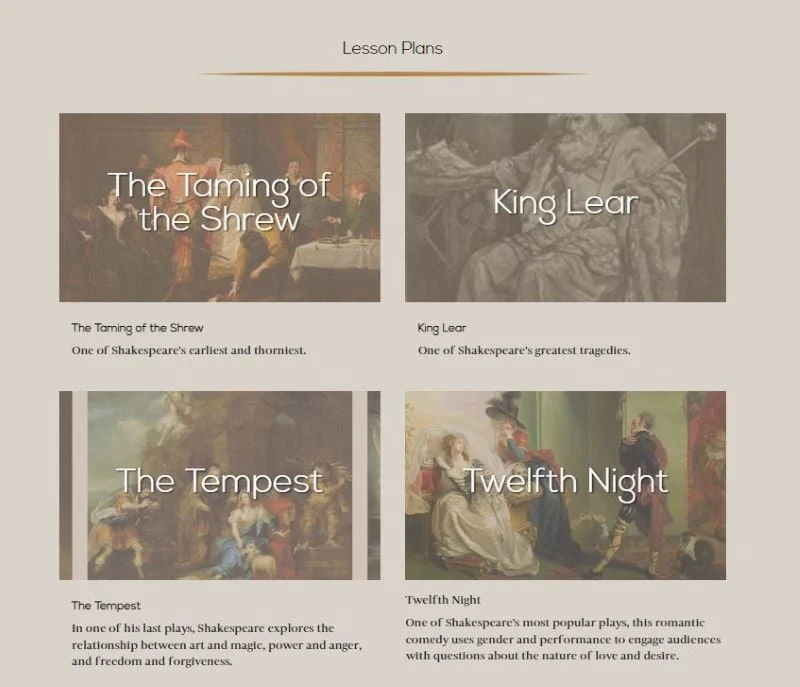
Remember from our definition of content marketing the importance of a clearly defined audience? These lesson plans from celebrated theatre company Santa Cruz Shakespeare are an excellent example of content designed specifically for students and teachers — a clearly defined audience segment. They bring a lot of value to this particular audience segment, giving them a fantastic reason to engage with the organisation.
The payoff is high for Santa Cruz Shakespeare. It establishes them as an authoritative resource on Shakespeare and on the kinds of events they produce. It also puts them on the map for any teacher or student who lives locally or even visits the area. It can also bring in audience members who are more familiar with Shakespeare’s work and therefore able to engage with the event in a deeper way.
If you are considering creating a downloadable resource like this, you can also think about how to turn it into a lead magnet — a piece of content designed to give you a potential audience member’s contact information. For example, you may include a form that asks people to sign up for your communications in exchange for a free download of the lesson plan.
Once you have collected contact details, you can start thinking about how to keep the conversation going with them and get them more involved through targeted campaigns. Better yet, you already have some information about what interests them, which you can use as a starting point for audience segmentation. For instance, the next time you are putting on a production of that particular play, you can send an email campaign to anyone who has previously downloaded the lesson plan.
Local highlights: “Area Spotlights” from American Players Theatre
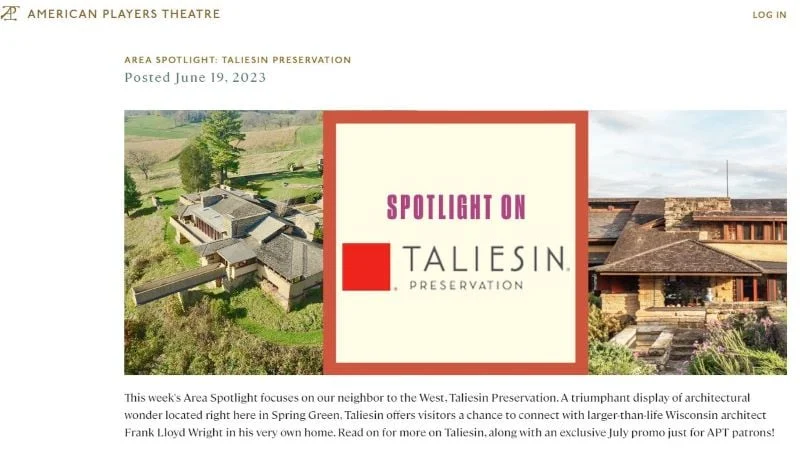
American Players Theatre, a renowned classical theatre in Wisconsin, has a great content strategy in place, featuring interviews with performers and staff, posts that go behind the scenes into their production process, and more. But one thing that really caught our eye is their “Area Spotlights” series, which highlights different local businesses and attractions near their venue.
At its core, theatre is about community, so these posts are a wonderful way to celebrate and strengthen that community. Meanwhile, from a performance arts marketing strategy perspective, they bring a number of benefits:
- Cross-promotion
Each local organisation they highlight is likely to share the post they have written, enabling APT to connect with new, relevant audiences. For instance, when the local inn shares its spotlight post, their guests will be introduced to APT and may even buy a ticket to an event during their stay. - Visit planning
The posts can help readers from afar envision a trip to Spring Green to visit APT, as now they have a clear picture of where to stay, what to eat, and things to do in addition to going to the event. They are able to picture the full in-person experience. - Local SEO
Every one of these posts digitally connects APT’s website to the area, so anyone who is searching for things to do locally is more likely to find them through a Google search. - Replicable, evergreen content
Evergreen content is not tied to a particular event or time period, so it can be published at any time, re-shared regularly, and gain a steady stream of views over time. Having this type of content can really help give your content calendar some breathing room.
Consider it a win-win-win. Any arts, culture, & live experience organisation around the world could certainly have its own area spotlight series.
Key takeaways for performance arts marketers
Hopefully by now you are brimming with ideas for the types of content you can use in your arts marketing. Now it is time to put those ideas into action.
Here are six quick tips for generating and embedding great content into your performance arts marketing strategy:
- Be clear about your target audience with each piece of content
There is an old adage that says to write with one person in mind. At every step of content creation — from planning to distribution — you should know exactly who will be reading or watching. We have said it already, but we will say it again: not every piece of content is meant for every audience member. - Explore your organisation’s creative work
Delve into the unique qualities of your programming and explore its wider context. This will help you uncover the things that make it unique and produce better content. Rather than just conveying the dry facts like price, reviews, and dates, explore its historical context, its subject matter, its style, the set design, the artists involved, and work out what could become engaging content. Ultimately, this means marketers and artists need to work closely together, sharing insight so that your content reflects the full experience you offer. - Produce evergreen content
Especially if you are pressed for time, create content that you can still use in a year so that you can repurpose it again and again for different channels. This could include FAQs, top-of-funnel content, local highlights, and more. - Actively distribute your content
Do not let that great content you are making develop cobwebs in a dusty corner of your website. Make sure to promote it across channels, and do not be afraid to re-post. Ask yourself: who is this content for, and what channels do they use? - Develop a sustainable process
In any performance arts marketing team, capacity and resources are precious. Be intentional about making space within your marketing plan, and do not try to do everything all at once. It is a marathon, not a sprint. - Support great content with effective use of digital tools
Your arts marketing software is a treasure trove of information for content creation and long-term audience engagement. Use your data to understand who your target audience is, what motivates them, and how different audience segments respond to different types of content. Segment your campaigns to get the right content in the right hands, connecting what you know about each audience segment with the content you create for them. And always, always measure and track your efforts, so that insights from one campaign can strengthen the next.
Audience members who value in-person experiences are often fascinated by what goes on behind the scenes, in rehearsal, and in the creative process. The activity that happens every day in your organisation is a rich source of content, and processes that you take for granted can have a real wow factor for readers not immersed in the work. Try out different content ideas to find out what engages each segment of your audience, and from there you will have a strong foundation on which your other marketing efforts can thrive.