Discover how clean data and meaningful segments support performing arts audience personalisation and help you respond to each customer’s wider relationship.
Your audience does not experience ticketing, subscriptions, education programmes, and giving as separate relationships. The person who buys a single ticket to your holiday show may be the same person who subscribes next season, brings a child to a workshop, volunteers as an usher, or makes a year-end gift. To them, it is one relationship with your organisation. The more clearly your data reflects that full relationship, the easier it becomes to engage audiences in ways that feel timely, relevant, and personal.
Performing arts audience personalisation creates a real opportunity and a real challenge. The opportunity is personalisation: reaching each audience member with the message that corresponds to where they are in their relationship with you. The challenge is that personalisation only works as well as the data underneath it. Skip the foundation, and even the smartest segmentation strategy will send the wrong message to the right person.
This roadmap outlines three practical stages every organisation moves through on the way to meaningful personalisation: building a data foundation your team can trust, creating segments that reflect real audience behaviour, and turning those segments into engagement visitors notice.
Why personalisation starts with data, not segmentation
On the surface, weak segmentation looks like a strategy problem or a time problem. Ask most marketing and box office teams, though, and the real issue is usually more fundamental than that: the data is incomplete, is inconsistent, or lives in systems that don’t talk to each other. Sometimes the most important information about your audience is not on a shared platform at all. It’s sitting in someone’s personal spreadsheet.
Over time, these gaps turn into real roadblocks, especially as staff leave and institutional knowledge walks out of the door. Meaningful segmentation depends on both accuracy and completeness. If your data is not clean and consistently managed, your segments won’t reflect your actual audience members, and campaigns built on them will underperform no matter how good the creative is.
This is why CRM data hygiene must come first. Clean data means you aren’t rebuilding your segmentation criteria from scratch every season. You build a segment once, trust it, maintain it, and eventually automate around it. Only when your segmentation is solid can true personalisation really begin.
Step 1: Build an audience data foundation you can trust
Messy audience data is rarely the result of one bad decision. More often, it reflects years of adaptation: growth, staffing transitions, urgent priorities, and teams doing their best with limited time. Understanding how that happens is the first step toward fixing it.
How patron data gets messy in the first place
- Ticketing and CRM migrations that carry old problems forward. Duplicate records, outdated coding structures, and incomplete history can survive a system migration intact. The database looks new. The data problems are not.
- Disconnected systems. Many performing arts organisations run separate platforms for ticketing, fundraising, marketing, and membership. When those systems are not integrated well, staff lose confidence in which one holds the most accurate picture of an audience member.
- Outdated data entry habits. Old campaign codes stay active, notes fields become catch-alls, and different teams develop their own naming conventions. Without shared standards, small inconsistencies build up.
- Informal training and unclear ownership. When database knowledge passes from person to person with no documentation, that knowledge often leaves when the person does.
What to prioritise first
You do not need a perfect database to move forward. You need one your team can trust and maintain. Start with the basics that touch every later stage of this roadmap:
- Set standards for new records. Require a valid name and either a current email or mailing address before a new customer enters your CRM, and apply the same standards to your online ticketing and donation forms.
- Catch up on duplicates. Build a routine process for identifying and merging duplicate customer records instead of letting the backlog grow.
- Standardise entry practices. A one-page data entry standard that everyone follows, covering naming conventions and required fields, prevents most of the drift that happens over time.
- Assign ownership. Someone on your team should own data quality the way someone owns ticketing or membership. Without clear ownership, even strong teams struggle to maintain consistency.
The goal is not a flawless system. It is a foundation clean enough that you can build segmentation that reflects real information about your patrons while eliminating duplicates and guesswork.
Step 2: Move from basic categories to meaningful segments
Once your data is in reasonable shape, segmentation becomes possible. Most performing arts organisations already segment their audience in some form, even if they have not thought of it that way. Think of the journey as progression: Crawl, walk, and eventually run.
Crawl: Start with the audiences you already know
If subscribers receive different communications than single-ticket buyers, you are already segmenting. Sending renewal information only to current subscribers is segmentation. Promoting a family programme only to families who have attended similar events is segmentation too.
At this stage, focus on the most obvious groups that need different messages: Subscribers versus single-ticket buyers, donors versus non-donors, mainstage audiences versus family-programme audiences, first-time attendees versus returning customers. Segmentation is just as much about excluding people from a message as including them. A customer who already bought tickets should not keep seeing ads for the same show, and a current subscriber does not need an acquisition message meant for a prospect.
Walk: Use behaviour to refine your messaging
The next step is behavioural segmentation: grouping audience members by what they have done rather than simply who they are. Past behaviour is usually one of the strongest signals of future behaviour.
If you are bringing back a popular artist, message the audiences who attended that artist before. If you are promoting a discount on a show with remaining inventory, target customers who have responded to discounts in the past rather than training your whole list to wait for one. And if audience members told you they are interested in dance, classical music, or family programming through a sign-up form or survey, use that information. A dance enthusiast does not need every message about every performance, just the ones that matter to them.
Run: Build a strategy that’s unique to your organisation
The most sophisticated segmentation strategies are built around patterns unique to your own audience data, not predefined categories like subscriber or donor. You might discover that audience members who live within 25 miles of your venue, attend at least one performance a season, and give £25 or more annually are far more likely to become loyal, long-term supporters. Or that households attending three or more performances in a season are strong candidates for a subscription.
This is where a clustering approach, grouping peoples with statistically similar behaviour into meaningful segments, turns your data into a genuinely custom strategy rather than a set of broad buckets. Whether you are just starting out or ready to build something this advanced, the important part is getting started. Every step along the crawl-walk-run journey builds a stronger relationship with your audiences.
Step 3: Turn segments into personalised engagement
Clean data and smart segments only pay off once they change what a customer actually experiences. In the age of streaming and custom recommendations, audiences expect something closer to a Netflix-level experience. They want you to know them. If your segmentation still stops at “all subscribers” versus “all lapsed bookers,” you are still treating individuals like generic groups.
Meet Jordan: One patron, many stories
Let’s consider a single patron named Jordan. Over the course of a year, Jordan buys four single tickets to a pantomime, signs up for your email list, upgrades to a subscription, brings a child to a family workshop, and eventually makes a gift during your year-end campaign.
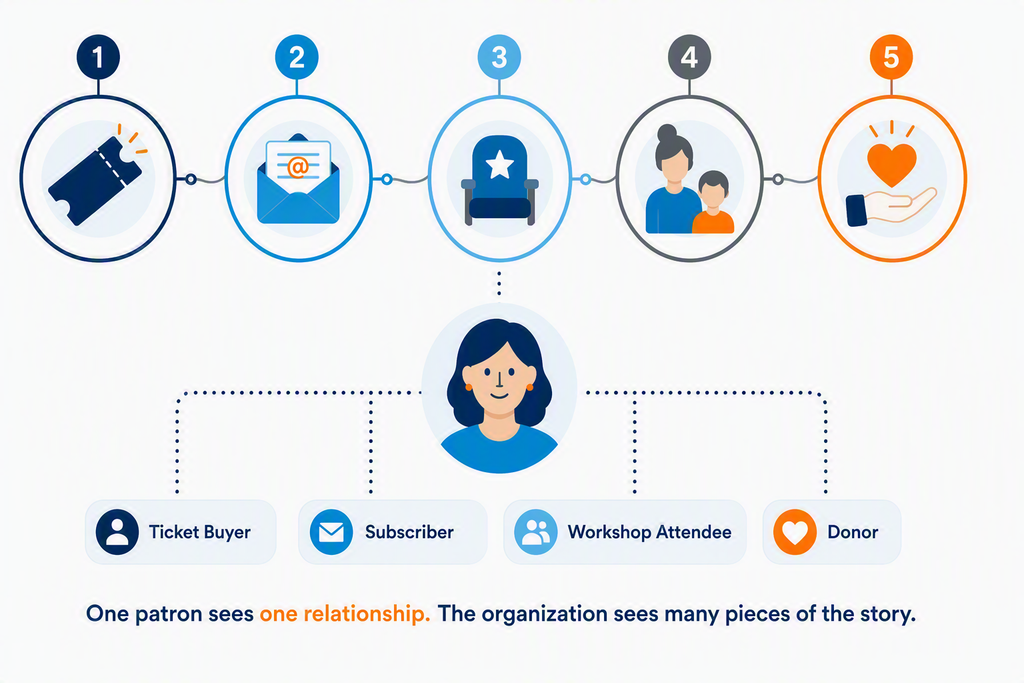
To Jordan, this is all part of one relationship that they have with your organisation. But ask five different departments about Jordan and you might get five different answers. Box office sees a ticket buyer. Marketing sees a subscriber who opens every email. Development sees a first-time donor. Education sees a familiar face from family programming.
None of those answers are wrong. They are just different pieces of the same story, and the story only becomes useful once someone connects the pieces. Without that connection, Jordan might receive a subscriber-acquisition email despite already being a subscriber, or a generic year-end appeal that never acknowledges the family workshop they attended twice. Personalised engagement depends on seeing Jordan as one individual, not five records.
Start with one pilot, not a full rebuild
You do not need to personalise everything at once. Pick one small, well-defined group and build a real pilot around them. New single-ticket buyers who attended a specific type of show, for example, could receive a short, custom follow-up series that highlights similar upcoming performances instead of a generic “thanks for coming” email.
Measure what matters most for that segment, whether it is a second visit, a subscription conversion, or a first gift, and use what you learn to expand the approach to the next segment. Personalised outreach is one of the most effective ways to move that number, because audience members can tell the difference between a message built for them and one built for everyone.
Where to start
Clean data, meaningful segments, and personalised engagement are not three separate projects. They are one continuous roadmap, and most organisations are already somewhere along it. The important part is knowing which stage you are in, rather than jumping straight to advanced personalisation on a foundation that cannot support it.
The Spektrix audience engagement guide explores how data, technology, and human insight can help you understand more of each patron’s relationship with your organisation.
Whether you are still working through duplicate records, ready to move from basic categories to behavioural segments, or looking to pilot your first truly personalised customer journey, the path forward starts with an honest look at your data. JCA works with performing arts organisations at every stage of this roadmap, from data cleanup and governance to segmentation strategy and audience analysis.