

4 min read
Anyone selling goods or services online runs the risk of experiencing payment fraud – and of course, that’s true for arts, culture, and events organizers, too. It’s unrealistic to hope that you’ll eradicate fraud altogether, but there is a lot you can do to reduce the impact if fraudsters engage with your organization.
We recommend a simple, three step formula:
-
Ticketing fraud detection through regular monitoring - you're in the right place!
-
Implementing measures to limit fraud without blocking genuine sales
The more effectively you can pinpoint fraudulent behavior – and separate it from legitimate sales – the better you can protect your organization from losing revenue.
So, what should arts, theater, and event leaders be looking out for? The answer lies in two key metrics:
Chargeback rates | Authorization rates
Track these two metrics regularly, and - unless there’s any change - you can rest easy. You don’t need to monitor anything else.
Change might be sudden, as strict fraud protection tools block high numbers of transactions, or gradual, as lenient mitigation measures lead to an increase in chargebacks. We recommend glancing at your metrics weekly, and monitoring more closely if you do spot any fluctuation.
If you already use Spektrix with Spektrix Payments, we do the heavy lifting for you. We’re continually monitoring for suspicious activity and leveraging machine learning to block suspicious transactions. If we spot a new or increasing concern, we’ll reach out to let you know and work with you to agree next steps.
Our goal is always to minimize the impact of fraud, without adding friction for legitimate patrons.
Do you have a payment fraud problem?
There are many different types of payment fraud, as well as wider fraudulent activity in ticketing that doesn’t relate to payment processing.
If you aim to reduce every type of fraud to zero, your first problem is not with fraud - it’s with expectation.
You will never increase your authorization rate to 100%.
Anything up to about 5% of failed transactions reflects a mixture of honest mistakes - genuine customers entering their details incorrectly, or failing to top up their account before buying - and your tools working correctly to block fake transactions.
You are unlikely to reduce your chargeback rate to 0.
Sadly, a handful of chargebacks are to be expected, representing a mixture of friendly fraud and malicious actors. If you do reach chargeback-zero, it’s almost certain that your authorization rate will drop significantly, and the lost income will outweigh the costs and effort of fighting chargebacks.
Payment fraud benchmarks for live events and culture
To know what good or bad means for your organization, it’s helpful to understand what normal looks like for other theatres, performing arts centres, or attractions.
That’s where the scale of the Spektrix community can help. In 2025, we processed 5.2m transactions including tickets, memberships, subscriptions, donations, and more, on behalf of 461 organizations across the US, Canada, UK, and Australia. The number of clients using Spektrix Payments, combined with our years of experience supporting the arts and culture sector, mean we’re well positioned to share industry-specific benchmarks.
When should I worry about chargebacks?
Reach out to your payment provider to learn how you can monitor your own chargeback rate. If you’re using Spektrix Payments, relax - we’re monitoring continuously on your behalf, and we’ll reach out if we identify any concerns.
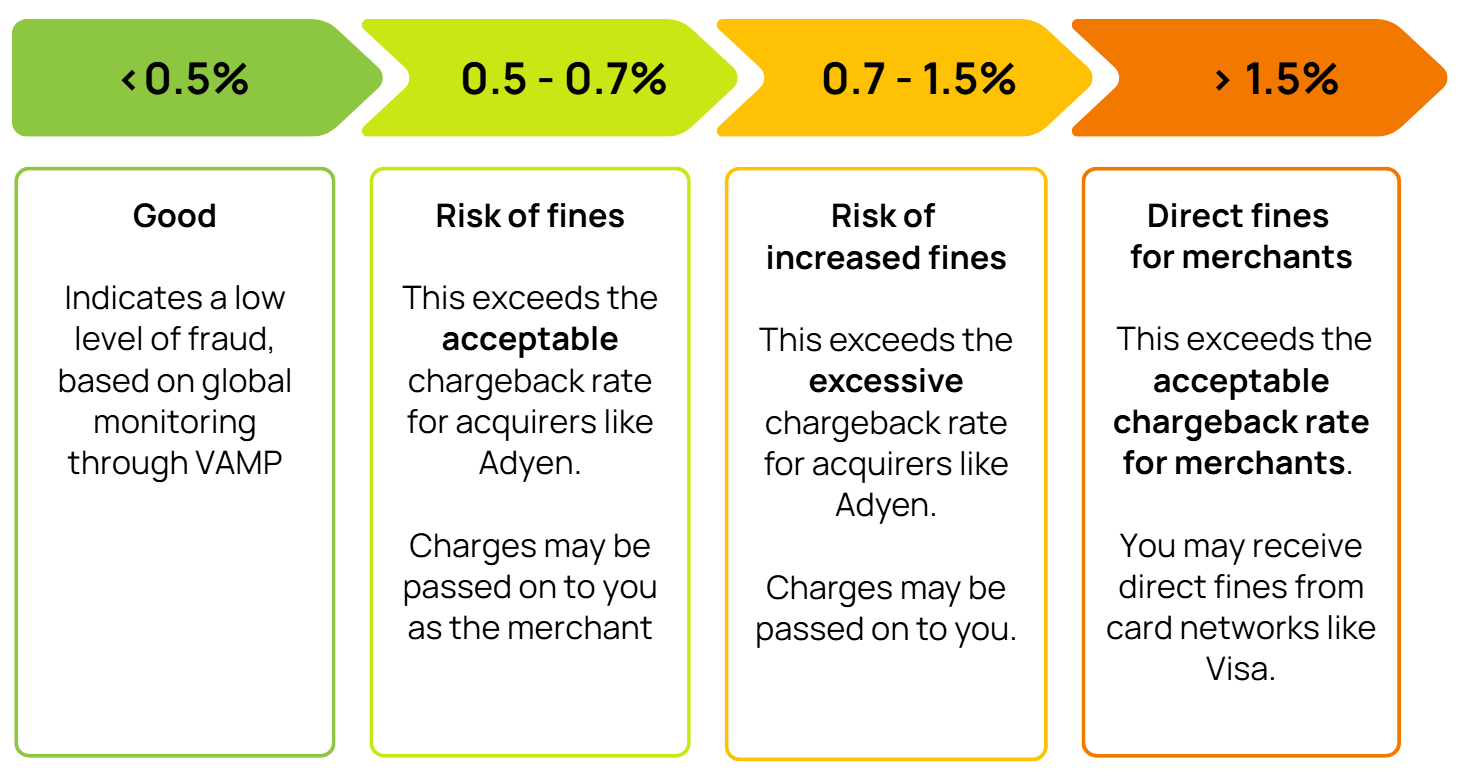
The average chargeback rate for Spektrix Payments users in the US and Canada is 0.07%.
“Acceptable” limits for chargeback rates are defined by card issuers like Visa. In 2025, Visa launched the Visa Acquirer Monitoring Program (VAMP) to provide a unified program to monitor and limit high-risk activity - replacing previous, separate, dispute and fraud programs.
In 2026, VAMP is lowering the “acceptable” chargeback rate to 0.5%. While that’s technically the rate it quotes for acquirers like Adyen or WorldPay, it’s likely that those acquirers will pass any fines imposed by Visa on to merchants (e.g. you). While direct fines for merchants only start at 1.5%, it’s therefore sensible to aim for a chargeback rate below 0.5%.
Remember that chargebacks can be filed at any time up to 120 days after the initial transaction. That means chargeback reduction is a long game - if you make adjustments to your fraud mitigation strategy, allow time for those changes to influence your data, and don’t worry if there’s a tiny spike that lasts only a day or two.
What to do with this information
-
If your chargeback rate is above 0.5%, contact your payment provider for advice.
-
If your chargeback rate is increasing, consider implementing additional payment fraud mitigation options, or contact your payment provider for advice.
Look for unusual purchase patterns over recent months which might explain the change - for example, high-value purchases made by new international customers - as these can help you identify the most relevant mitigation steps. -
If your chargeback rate is below 0.5% and stable or decreasing, you may well have the right balance between risk and friction. If you’re still concerned, try implementing some low-friction mitigation options like introducing Apple Pay - but be careful to set realistic expectations for your stakeholders.
When should I worry about authorization rate?
Reach out to your payment provider to learn how you can monitor your own authorization rate. If you’re using Spektrix Payments, relax - we’re monitoring continuously on your behalf, and we’ll reach out if we identify any concerns.
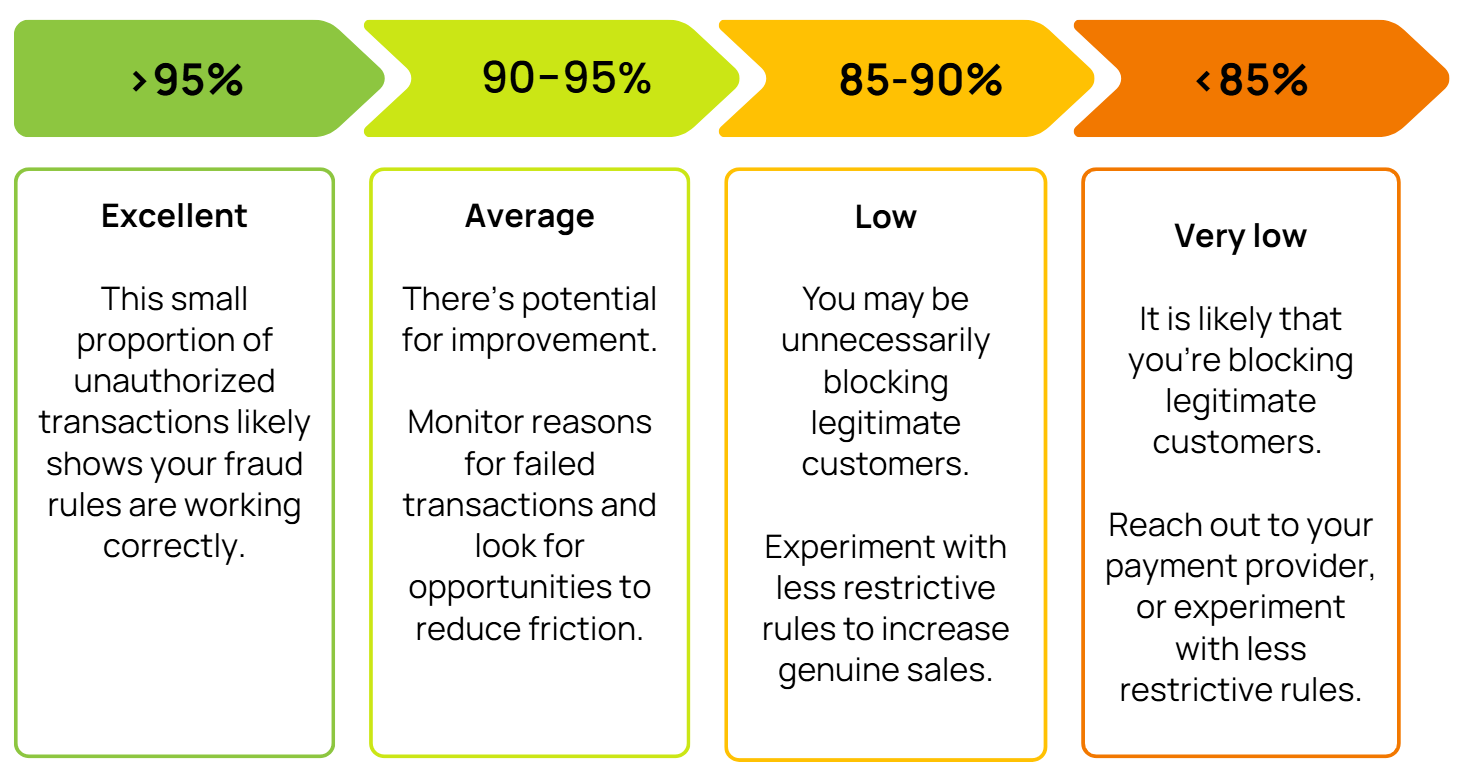
The average authorization rate for Spektrix Payments users is 95%.
Authorization rates aren’t managed centrally by a program like VAMP. This ticketing fraud detection measure is more about understanding why some transactions will always be blocked, and understanding what “normal” looks like for your organization.
If there’s a significant reduction in authorization rates, the good news is that it will appear in your metrics right away - giving you the heads up you need to investigate and adjust your fraud mitigation options if you find they’re too restrictive.
What to do with this information
-
If your authorization rate reduces suddenly, contact your payment provider for advice.
Look for additional measures to explain and help address the change, like multiple failed transactions using different card numbers, but the same billing address. These should appear in your metrics immediately. -
If your authorization rate is below 90%, we recommend easing some of your fraud mitigation steps - especially if authorization rates are stable, and chargebacks remain low.
-
If your authorization rate is below 95%, you may consider easing some of your fraud protections - but there’s no urgency to do so, if you’re not hearing customer complaints.
-
If your authorization rate is at or above 95%, it’s likely you’ve got things right. That last 5% is likely to represent a mixture of:
- Human error, as people mistype their card or address details.
- Transactions blocked by patrons’ own banks, either because of insufficient funds or security concerns on their part.
- Your mitigation measures doing what they should, by blocking a small number of fake transactions.
Still not sure what to do for the best?
Get in touch. Whether or not you’re using Spektrix today, we’re happy to share our experience of supporting hundreds of arts and events venues to monitor and reduce payment fraud. Find out more about Spektrix Payments services, and reach out to learn how we could help you.
