

 Bryony Bell
Across the arts, culture, and live events sector, a familiar narrative has taken hold: teams are stretched, workers are burned out, and the most committed professionals are leaving for better conditions elsewhere. But does this story stand up to scrutiny?
To find out, Spektrix surveyed 268 professionals in audience-facing roles - marketing, ticketing, fundraising, and leadership - across the world. The results reveal a workforce defined by deep resilience, but one that is also approaching a critical breaking point. For organisations in the UK, understanding these 'push and pull' factors is the first step toward a sustainable strategy for employee retention.

The majority of arts and events workers plan to stay in the sector - but a significant number are yet to decide
High turnover in the arts, theatre, culture, and events workforce isn’t guaranteed. A surprisingly small proportion of workers are determined to leave, though 20-30% are at risk if conditions don’t improve.
Where do you see yourself working in five years' time?
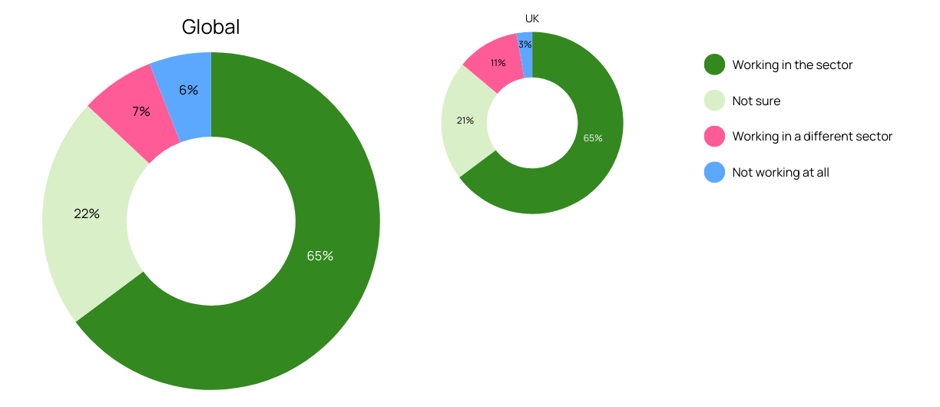
- Globally, a remarkable 64.8% of workers plan to continue working in the sector five years from now. The UK the proportion's right on trend at 64.8% exactly.
- Only 7.1% globally plan to leave for a different sector within the next five years. That rises to 11.1% in the UK.
- That leaves a significant number of sector employees who have not yet decided their next steps. 22.1% of the global workforce are unsure where they’ll be in five years, dropping slightly to 21.3% in the UK.
There’s a huge opportunity to retain undecided workers, and to reward the experienced, dedicated people who plan to stay in their roles.
The power of purpose: Employee retention is driven by a deep belief in social impact
What keeps people at their desks despite the challenges? For the vast majority, the answer lies in the social and cultural impact of their work.
“I have a strong conviction that participation in the arts and humanities is critical to just being a good human and member of society and that a lot of problems in the world could at least be helped by choosing to explore different worlds and perspectives via the arts.”
Marketing manager, 35-44, US municipal arts center
- 91.1% of respondents globally agreed that their work has a positive influence on audiences and communities. This drops slightly in the UK, but remains positive at 81.2%.
- This compares to just 51% of all UK workers who agreed that their work was useful to society.
The work I do has a positive impact on society:

So what does social impact look like? Written responses showed that arts and events workers carry a deep sense of obligation, importance, or responsibility - a belief that connecting audiences with the arts has a profound impact on individuals, communities, and society as a whole.
“I live in a polarized community, and I believe the arts are something that most people value and can bring people together, increase empathy, and build unity.”
Production department lead, 35-44, US university venue
Influencing forces: Why are workers leaving the arts and events sector?
Workers’ commitment is something to celebrate - but also a cause for concern. Their sense of obligation to the sector and society risks enabling a culture in which low pay, limited progression opportunities, and unmanageable expectations are the norm, and where passion turns to burnout and resentment.
1. A genuine struggle to make ends meet
Low pay is the primary reason for leaving the sector, with a third of exit decisions driven by inadequate compensation or benefits.
In the UK, only 35.1% of respondents feel their pay is fair and proportionate - significantly below the 51% satisfaction rate seen in wider US workforce benchmarks.
“I don’t want to go anywhere. Not at all. There’s no place like this, and I want the theater to succeed. But I just don’t know if the board understands the strain of the current salaries. We do offer health insurance, but I get mine through the Affordable Care Act exchange. My salary is low enough that I qualify for subsidies.”
Leader, 55-64, US independent arts center
2. Limited opportunities for progression
Workers at almost every level feel they’re learning and developing new skills - but workforce development is informal, and opportunities for progression and promotion are low.
- 68% of UK-based respondents feel they have opportunities to learn new skills.
- However, only 27% of the UK live events workforce are satisfied with their opportunities for promotion - only slightly over half the national benchmark of 38%.
3. Progression comes at the cost of work-life balance
For workers who do progress to senior leadership and executive roles, work-life balance is seriously askew. Leaders often find themselves doing multiple jobs, managing high-level strategy while simultaneously dealing with ground-level issues like building maintenance or staffing shortages.
“I do think there’s a real difference between senior roles in the arts and senior roles elsewhere in the charity sector. In many charities, people at CEO level aren’t worrying about coffee spills or alarms not setting. In our sector, even at senior level, you’re still right there dealing with the issues on the ground. And that difference really matters.”
Leader, 45-54, UK independent venue
How to retain audience-facing team members in the arts and live events
While pay remains the foundation for employee retention, it isn't the only lever. Many workers will accept lower financial rewards - provided they can continue driving social impact.
- 74.1% of workers globally say work mostly or completely lives up to the promise it held when they entered the arts or events sector.
- That’s only slightly lower in the UK, at 69.5%.
“I freaking love my job, love the organisation I work for, and believe in its mission. It's been almost 19 years since I switched careers to working in the performing arts. While I'd love to earn more money (and realistically could with what I do) I wouldn't sell my soul again for any amount of money.”
Data analytics manager, 55-64, Canadian independent festival
Organisations can’t rely on improved government funding or sector-wide growth to improve working conditions. But there are actions that leaders can take now to ease pressure, protect wellbeing, and strengthen the case for higher pay in the future.
In the short term, those changes could tip the balance for committed people, giving them the working conditions they need to keep them in the sector.
And in the long term, this could enable teams to drive even more powerful outcomes - growing revenue, connecting with audiences, and delivering even greater impact in their communities.
What would help you spend more time on the parts of your work that bring you joy?
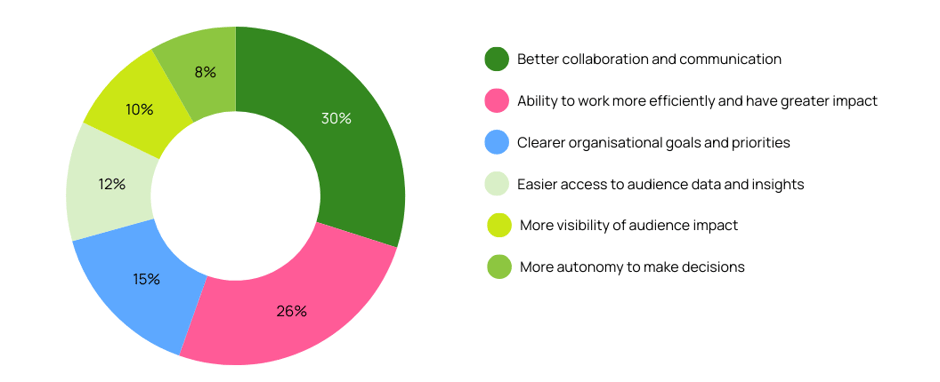
When asked what would help them spend more time on work that brings them joy, respondents worldwide prioritised cultural and operational shifts:
- Almost a third, 29.9%, called for better collaboration and communication across teams as their priority.
- A quarter, 25.5%, felt it was important that they could work more efficiently and build greater impact.
Investing in resilience
The people whose work connects audiences with the arts and live events are pragmatic, altruistic, and ready to lead. Many respondents - unsurprisingly - wanted to increase budgets. Few asked for that change in isolation. They recognised the difficulties facing the sector and its leaders, and sought the chance to face the challenge together.
With a quarter of the workforce questioning their future - and the most talented and dedicated team members stretched to the bone - it’s increasingly vital that organisations make that commitment.
There’s potential to stabilise teams and ensure the arts continue to thrive, by:
- Building a culture of transparency
- Prioritising efficient processes
- Creating clear pathways for growth
Leaders must dare to invest - because the sector can’t risk standing still.
