Prioritise your work with clear frameworks and data-led insight, reducing firefighting and focusing on decisions that matter.
Leadership in arts and culture is defined by competing priorities. Decisions affect audiences, staff, communities, and financial health, often all at once. The challenge is not deciding what matters. It is deciding what matters now, in ways that support long-term impact for your audiences, staff, and communities.
Powered by Purpose, the Spektrix report into employee retention and workforce development in the arts, reflects the human impact of this challenge. While arts and events professionals are deeply committed to their work, many are operating under extremely high workloads, with limited resources and little protected time for long-term development.
This blog provides simple frameworks showing you how to prioritise your work more effectively. Clear guidelines and data-led decisions will reduce firefighting and help your people work more effectively.
When everyone is excited to contribute ideas, it can be hard to land on the best one straight away. I also think we can be quite reactive to concerns – if we hear something once, we sometimes assume it must be a problem. Some things really do need an immediate response, but others don’t need action at all, or could benefit from waiting and seeing.<br />
For me, the question is about impact: are we doing the things that will make the most meaningful difference, or are we responding to everything as it comes to our attention?Ticketing department lead, 25-34
Canadian independent venue

The human cost of constant urgency
Arts, culture, & in-person experience organisations operate in high feedback environments. Audience responses are immediate. Financial pressures are real. Staffing gaps are often felt instantly. In that context, reacting quickly can feel synonymous with doing a good job.
But constant urgency comes at a cost.
When teams spend most of their time responding to the loudest issue in front of them, important but less visible work is consistently deprioritised. Strategic planning, audience development, data analysis, process improvement, and staff development are postponed – not because they don’t matter, but because they don’t demand attention right now.
When everything feels urgent, teams are left firefighting – and firefighting is exhausting.
Responsive v reactive decision making
There’s an important distinction between being responsive and being reactive.
Being responsive means paying attention to the issue at hand, but pausing long enough to understand context, weigh impact, and choose actions intentionally. Being reactive means responding automatically, often based on incomplete information or immediate pressure. Knowing how to prioritise your work means understanding this distinction and applying it to each decision.
In mission-driven organisations, like Spektrix and many of the organisations we work with, reactivity is understandable. When people care deeply about outcomes, ignoring a hot issue can feel irresponsible. But without clear prioritisation, reactivity can quietly crowd out the work that could reduce pressure in the future.
Over time, this creates predictable problems:
- Strategic initiatives stall or never fully launch.
- Decisions are made based on anecdote rather than insight.
- Teams feel busy but disconnected from long-term goals.
- Leaders become bottlenecks for every decision.
The result isn’t just inefficiency. It’s a loss of confidence – from team members and audience members – in the organisation’s impact.
How to prioritise work under pressure
One of the most effective tools for navigating this tension is the Eisenhower Matrix, also known as the Urgent–Important Matrix.
Used well, this framework is more than a personal productivity tool. It can act as a shared lens for decision making. Leaders can use it alongside teams to prioritise work collectively, align expectations, and reduce unnecessary escalation.
The matrix categorises tasks along two axes: urgency and importance, creating four distinct quadrants. This structure helps teams move beyond linear to-do lists and toward more thoughtful prioritisation.
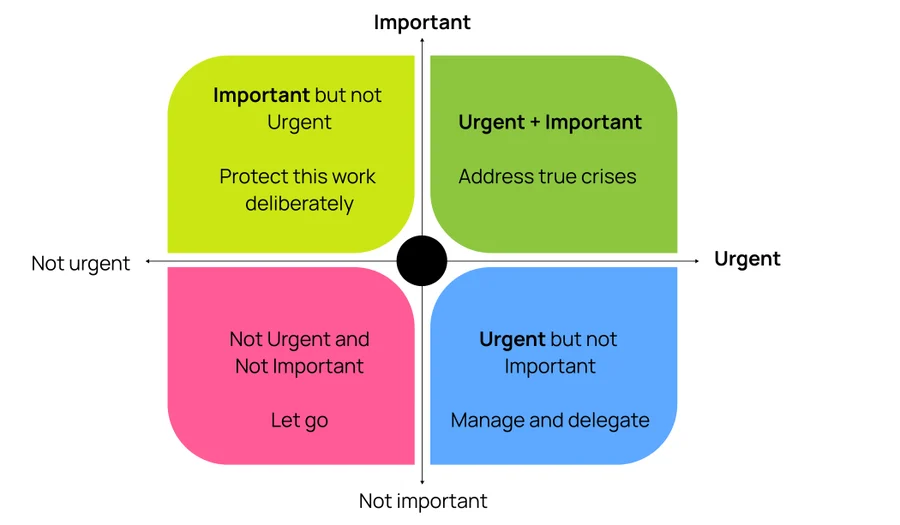
Urgent and Important
Address true crises
These tasks require immediate attention and have clear consequences if delayed. They deserve focus and fast action. But if everything lives in this quadrant, it’s a signal that something upstream needs attention.
In your theatre or event venue:
Unexpected operational disruption, ticketing system failure, or a serious audience accessibility issue.
Urgent but not Important
Manage and delegate
This quadrant is often larger than teams realise. Many tasks feel urgent because they interrupt the flow of work, but don’t materially affect long-term outcomes.
Reducing time spent here often comes down to clearer ownership, better processes, and shared expectations about what truly requires immediate escalation.
In your theatre or event venue:
Emails, meeting requests, last-minute asks – especially from leadership.
Not Urgent but Important
Protect this work deliberately
This is the quadrant where long-term impact is built – and where it’s hardest to prioritise time.
Work in this area shapes everything else. When leaders don’t intentionally protect time for this work, it’s perpetually postponed. Powered by Purpose highlights the importance of creating protected space to reduce the fatigue of constant firefighting and support more confident, contextual decision making.
In your theatre or event venue:
Audience strategy, technology review, learning, data infrastructure, accessibility planning, staff development, process improvements.
Not Urgent and Not Important
Let go of outdated work
Every organisation carries legacy tasks and outdated processes that persist out of inertia. Naming and removing this work isn’t indulgent, it’s critical. Letting go creates space for what actually matters.
In your theatre or event venue:
Recurring meetings, manual tasks that could be automated, internal bureaucra
The challenge of prioritisation in mission-led organisations
Arts and culture organisations are mission-led, people-focused, and publicly accountable. Leaders and teams often feel a deep sense of responsibility to audiences, funders, boards, and staff, which can make saying “not now” – or even “no” – feel uncomfortable.
Earlier in my career, I worked in disaster services communications with the American Red Cross. The work was, by definition, urgent. When a disaster occurred, immediate response was essential. But even in that environment, there was a clear directive to invest time in prevention, preparedness, and long-term resilience.
Without that commitment to “important but not urgent” work, disaster response would remain purely reactive – jumping from crisis to crisis without reducing future risk.
For a concrete example of how arts leadership can turn prioritisation into shared priorities and sustained change, read our case study on arts leadership at St. Ann’s Warehouse.
It may not quite be disaster response, but arts and culture organisations deliver a mission that’s vital for the wellbeing of audiences and communities. Dedicated, purpose-driven teams risk being swayed by good intentions, which leaves already-stretched people working constantly in crisis mode and failing to make space for long-term planning, data, and process improvement.
If you’re looking for practical ways to move from burnout to breakthrough and build a thriving organisation, explore our session on building a thriving organisation.
I often hear from colleagues – and friends at similar organizations – who feel so frustrated they’re hitting a wall and thinking, ‘I can’t do this anymore.’ They’re deeply passionate about the work, but the obstacles make it feel impossible to do it in a way that really matters to them. Sometimes that pushes people out of the sector altogether, into roles that might feel easier – not because the work is better, but because they care less about the outcomes, and so the obstacles don’t hurt in the same way.Ticketing manager, 25-34
US independent arts centre
Using data to drive effective prioritisation
Without objective measures, it can be difficult to prioritise your work. A single complaint, anecdote, or internal concern can feel like a call to action, even when it doesn’t reflect broader patterns.
Data provides essential context.
Audience insights, attendance trends, engagement metrics, and revenue data allow leaders to distinguish between isolated issues and systemic challenges. They help teams ask better questions:
- Is this a one-off concern or part of a trend?
- What’s the long-term impact if we act – or don’t?
- How does this align with our strategic priorities?
Importantly, data doesn’t remove judgement from decision making; it strengthens it. When teams share a common purpose and a shared evidence base, decisions feel less reactive and more intentional, and confidence increases as a result.
Prioritising work is a leadership responsibility
Work overload is often framed as an individual productivity problem. In reality, prioritisation is an organisational and leadership responsibility.
Clear priorities empower teams to make better decisions independently. They reduce bottlenecks, prevent unnecessary escalation, and create alignment across departments.
Prioritisation is also a core tool for building high performance teams in arts, culture, and live experience organisations. To explore this further, read our article on building high performance teams in arts, culture, and entertainment.
In theatres and other cultural organisations, where roles often overlap and teams are small, clarity matters more than control. When people understand what’s important and why, they can respond thoughtfully and autonomously, rather than defaulting to firefighting.
This is where prioritisation becomes a leadership decision, not a personal habit.
Protecting important work when time and funding are tight
No framework can magically create more time or funding. But ensuring that you, and your team, know how to prioritise your work can help your organisation use resources more effectively and sustainably.
Some practical starting points include:
- Reviewing work as a team using the Eisenhower Matrix.
- Explicitly blocking time for “important but not urgent” initiatives.
- Using data to validate perceived urgency.
- Regularly sunsetting tasks and meetings that no longer serve priorities.
- Normalising delayed responses when immediate action isn’t required.
These shifts don’t require perfection. They require consistency and leadership permission.
Prioritisation is how we prevent burnout
Leaders in arts and culture are stewards of both mission and people. That stewardship includes turning down the dial on burnout – not by asking teams to care less or do less, but by being more deliberate about where effort is focused.
When everything feels urgent, people are forced into constant reaction mode. Over time, that erodes energy, confidence, and belief that the work will ever become more manageable. Better prioritisation doesn’t eliminate pressure, but it does reduce unnecessary strain by creating clarity: about what truly matters, what can wait, and what can be let go.
When organisations shift from reactive decision making to responsive, data-led prioritisation, they create space for work that sustains impact over time. Just as importantly, they send a powerful signal to their teams: that long-term thinking is valued, that not every issue requires an immediate response, and that sustainable pace is part of success.
In a sector defined by purpose – and increasingly shaped by burnout – knowing how to prioritise your work isn’t about doing less. It’s about doing what matters, with intention, at a pace that people can sustain, and in a way that allows impact to grow rather than exhaust the people creating it.